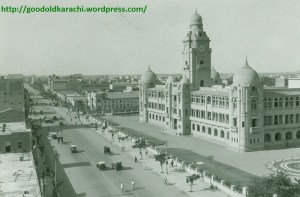
Old Karachi Photos

KarachiPastTramCamelCartTag

Posted in Uncategorized | Leave a comment

Goans of Pakistan

Footprints on the Sands of Time
By Menin Rodrigues 


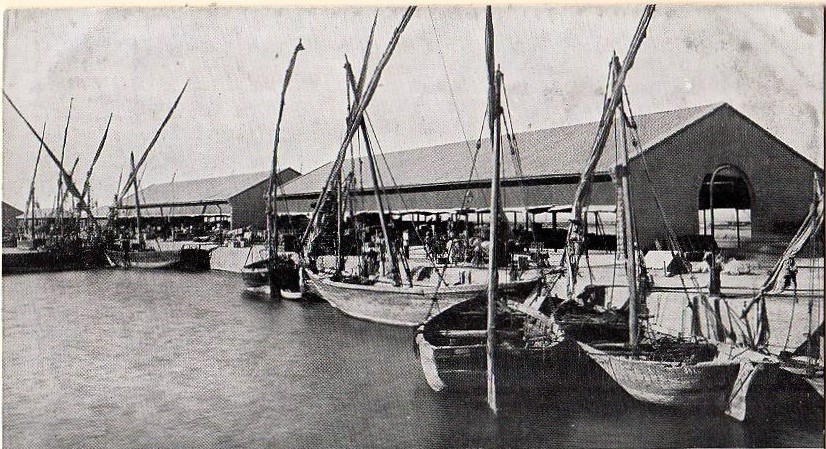
“The Portuguese influence and dominance goes back to the 15TH Century but the real transition of Goans (of Portuguese-Hindu pedigree) from one place to another – from Goa to Bombay, to Karachi, to Africa and other continents started, realistically speaking, sometime in 1820. When the British eyed Karachi as a future city of trade, commerce, leisure and strategy, and with Charles Napier occupying Sind, the advent of Goans in Karachi (Kurrachee) had begun. They came in dhows and anchored at the threshold of the city’s two ‘gates’ – Kharadar (Salty Door) and Mithadar (Sweet Door).

These enterprising people from Goa of pre-partition India have been living and working here, a sleepy fishing village-turned-megacity, since that time. They did not look back in their quest for a new homeland and prosperity, gave off their best, excelled in everything they touched, grew in numbers and affluence but gradually lost interest. Large number of families, like gypsies and nomads moved on, in search of greener pastures, leaving behind their trademark talents and footprints on the country of their choice, in this case, Pakistan. Though they have long gone, drifted away from the shores of their country, they will always have a little Pakistan in their hearts”

The above is from the website. Please visit the website for a more detailed report on the Goans of Pakistan:
http://www.goansofpakistan.org/

Posted in Contributions by Christians, Uncategorized | Leave a comment

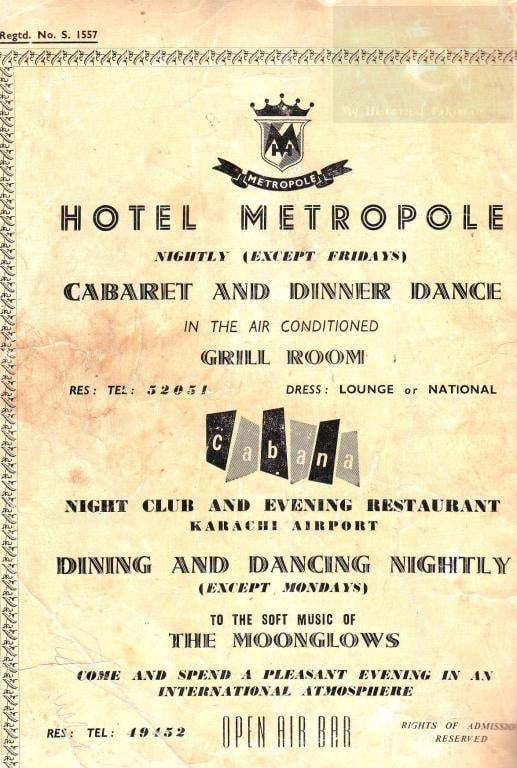
Hotel Metropole Karachi in the 1960’s

Hotel Metropole Karachi

Posted in Entertainment in Old Karachi | Leave a comment

Jewish Community in Karachi

JewishFestival

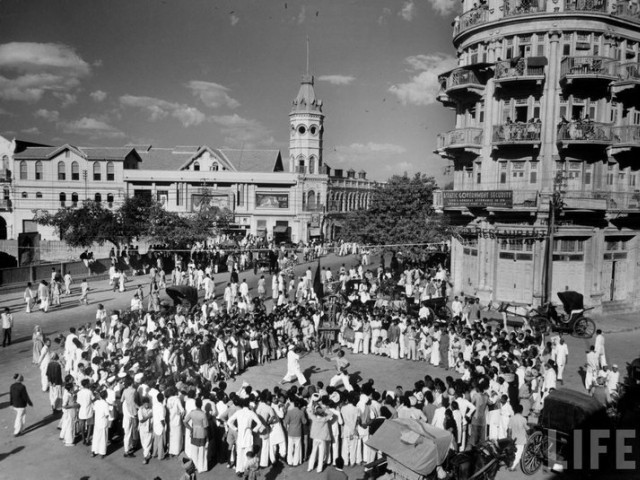
Jewish Festival in Karachi in the 1950’s.
Source of photo unknown.

Posted in Contributions by Jewish Community, Uncategorized | Leave a comment

The Karachi I Used to Know

The Karachi I used to know
Posted by 

 MajesticCinema1960s

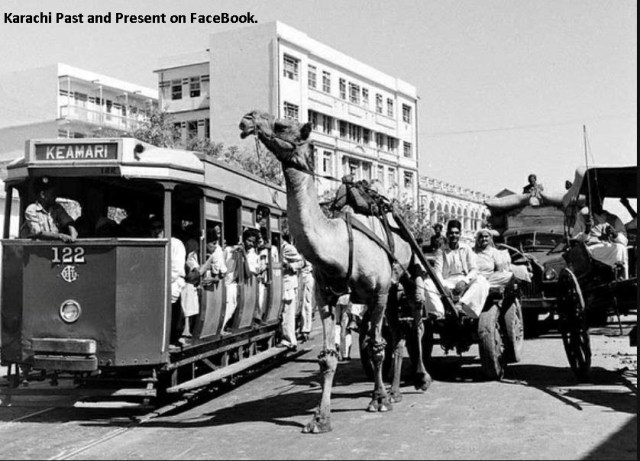
The hustle and bustle of trams in early 1970s.

Yesterday afternoon, I sat and watched with horror the events on TV, sans mobile phone and only some connectivity via email. Needless to say, it was frustrating, as the main focus of the anarchy was the area around my place of work.

How could humans descend to this level in a metropolis where commerce and 20 million lives function together in a place they call home?
Is this what humans do to their lives, friends, neighbours, communities and fellow citizens?
Having spent two thirds of my life in this city, I know in my heart that I belong here.

But this is not the Karachi I used to know.

I am solely motivated to write this article due to the Facebook group “I sure want my old Karachi back”. The nostalgia felt by the members has made me recall some of those expressed, vibrant memories.

This is my own diary and is not a catch all. It spans the period of mid 60s to mid 70s. My existence revolved around Karachi Grammar School, the hawkers, the eateries, some cinemas and a few sporting memories.

Beginning with the area of Saddar, school was a place of bliss, mainly because of friendships rather than studies. It revolved around a break, when we consumed Coke and patties, the taste of which has never been replicated. Home time was when the hawkers collected outside the school. There was the tek wala, who sold this sweet, gooey sugary stuff made into shapes like birds and musical instruments. Great taste! Sometimes there would be a jungle jalebi guy, and at other times there would be the mouthwatering gol gappas!

If we could not be picked up from school due to transport issues, we would walk down to Empress Market and Trampatta Road. Ah, those jingling warnings of approaching trams, lost forever in the folds of time. Lined up on those hustling streets were the wonderful gannay ka ras (sugarcane juice) and lassi vendors for people to quench their thirst in the blazing summer. Even the prices were amazing; a 50 paisa coin would suffice all.

Golden era of Karachi: simple yet vibrant.

Annually till March, athletic games were held at Webb Field (now Macro). My neighbours and I would traverse through the old Lines Area to get to the ground. We used to live in PECHS, so we had quite some miles to walk. This routine included a stop at the faluda cart. No faludahas ever tasted like the one that cart had to offer. The tukh malanga in the faluda was great to keep us cool throughout the afternoon practice. On the way back, one would sometimes stop by the a bakery called Sandooq  for low price cakes and pastries galore!

In those days, Karachi came to life at night with a lot of activity on offer. You would see people at parks like Polo Ground, Frere Hall and Hill Park. Clifton, on the other hand, was quite different; high tide used to reach upto the Kothari Parade.

Memory has faded, yet I can recall the cry of “chana choor garam”…a spicy, dry concoction. Sometimes one would go to Playland and have a few games of pinball. The Makranis used to play Foosball and were masters of it.

People would dine out at various places, but posh restaurants were only few. A crowded Bundu Khan remains distinct in my memory. The Chinese ABC restaurant is not like anything I have ever eaten again. James Lee, the son of the restaurant owner was in my class, so maybe I am biased. Vague memories of Burns Road (better known as ‘Banns’ Road), with its dhaga kababsheer maal and nihari, surround me, though I was never sure where we would eat, at  Waheed or Saabri.

I vividly remember Hotel Farooq and its succulent chicken tikka. In the later years, Tariq Road surfaced (called the Commercial Area in those days) and restaurants such as Café de Khan, Tung Nan and Silver Spoon for their Kebab rolls became the talk of the town. At that time, some great Bengali stuff was also available at Mishti Mukh. On my first visit there, I ateshaundesh.

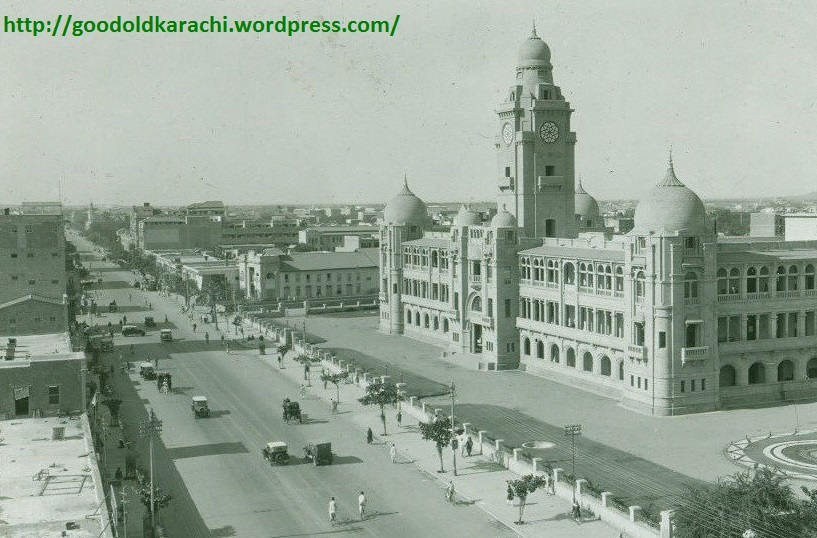
Bright lights surround the KMC building.

As we grew older and were able to drive, we would sneak out of school a few times, depending on our negotiation with the security guards. I clearly remember two highlights of these trips. Firstly, daal kee puri, pretty common nowadays, was available at Commissioner Office, across from Trinity Church. Then there was chullu kee chaat, at Soldier Bazaar. This particular guy would continue cooking the chaat until it became almost like mush. One bowl was a meal in itself.  Occasionally, we would visit Shezan or Café George at Saddar, however, these visits mostly took place in the morning, nevertheless the tea and cake piece were out of this world, especially if you are bunking math.

Pride Of Place was our hangout spot during Sunday afternoons, when sometimes one would either get a jalebi, samosa or dahi phulki from Fresco, near Pakistan chowk.

In terms of cinemas, we preferred Bambino, but in later years Capri became more trendy. There were others like Rex on Victoria Road and Palace at Metropole. I remember watchingBlue Max post exams in grade eight and My Fair Lady in 1970 late at night at Palace. In addition, I vaguely remember watching Hatari at Palace in 1964. Soon came the phenomenon of the Drive-In Cinema. I don’t remember any of the movies that were screened, but it used to be exciting to go there. It was located on the Dalmiya Cement Road. I also recall watching this crazy movie called Walking Tall, late at night at Capri with friends. Going to a movie was always exciting and is totally unlike our download culture now.

Karachi: the fast-paced city of lights.

Lastly, sports. Besides the school stuff there was a lot going on at the National Stadium. Test matches were few and far between, but first class used to abound. Remember Hanif scoring 190 in a match in 1970 after he had retired from tests. The entry was free and approximately 500 people used to come there to watch te game. When it came to Test matches it was difficult. Tickets were not easy and the facilities stretched. I remember the time when Mushtaq got run out for 99 – there were three 99s in that match – vs England in 1973. Also, there was this sad match when Hanif retired in 1969.

The culture of Pakistan then was free and one could move around without fear. No go areas were non-existent; people laughed and enjoyed themselves, besides getting on with the serious business of earning a living. There were nightclubs and discos (I was too young to go to these!) and those who went were allowed to – no one threatened anyone else’s existence.

This was a city in harmony and at one with its inhabitants. We as a city were not rich, but we lived together and were a larger community. I prays that those days come back to us again and our new generation can live like we used to ─ happier and united!

Posted in Karachi Recalled | 1 Comment

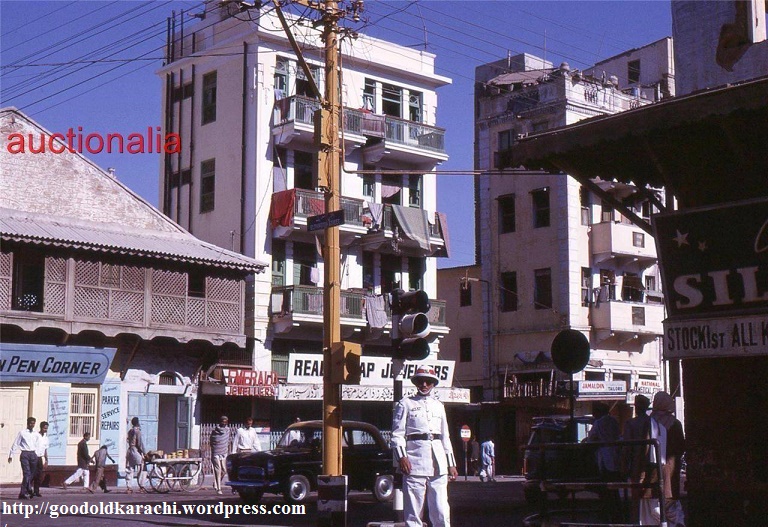
Clark Street Saddar 1970’s

ClarkStreetSaddar1970sC
Frozen in time.  Clark Street, Saddar, Karachi of the 1970’s with a smartly dressed Traffic Police. (corrupt but less so; would be happy with Rs 5 for driving without  driving license!);  The Pen Corner was Agha’s Pen Corner (or Fountain Pen Corner) who sold and repaired Parker Pens and Mont Blanc Pens)   Real Cheap Jewelers (not sure how cheap though) There was a Pakola Depot further on with Regal Toyland next to it.
Note the cart with Dalda Ghee cans, probably for re-cycling ( Karachi was re-cycling way before the West;  paper, glass, metal, plastic, you name
it.)
Information courtesy of Mr. Feisal Rehimtoola and Edwin Figueredo, et al, veteran Karachiites.
Regards
Amin H. Karim
Houston
Posted in Karachi Recalled | Leave a comment

Pakistan Radio Artist S.M. Saleem


DramaRadioPakistan

Remembering S.M.Saleem Radio Pakistan Artist:
Late S.M. Saleem was a veteran radio artist in the 1960’s who later migrated to USA and settled in Houston, Texas. Here he introduced a radio program “Kehkashan” on Saturday mornings One of his sons Dr. Agha Sahir Saleem has a facebook page dedicated to his memory and more photos. Dr. Saleem practices Pulmonary Medicine in Houston. Mrs. Suraiya Saleem used to read the English News for overseas Pakistan at 2 AM from Radio Pakistan. In Houston she taught English at the Bellaire High School and is now retired. In the photo Mr. Saleem is on the left with other Radio Pakistan artists Khadija Naqvi, Shamsudin Butt, M.A. Razzaq and others; S.M. Saleem used to do a popular Saturday evening radio show called “Dekhta Chala Gaya” which was part of the skits program “Kehkashan”. On Sunday nights he often participated in dramas called Studio Number 9. There was no TV and radio was one great source of family entertainment. His sweet and melodious voice with impeccable Agra Urdu was a treat and a memory difficult to erase. I once asked Mrs. Saleem if she has any audio tapes of his programs. Unfortunately, they were lost in Houston flooding
S.M. Saleem acted in many Pakistan TV dramas after 1964 when TV was first introduced in Pakistan.
Photo courtesy of Agha Sahir Saleem. 

Posted in Karachi History | 1 Comment

First Men on the Moon in Karachi

ArmstrongKarachi1970s

The first men on the moon land in Pakistan. Astronauts Neil Armstrong and Buzz Aldrin (the first men to land on the moon), arrived in Karachi in early 1970 during their tour of South Asia. Here they are seen being greeted by an enthusiastic crowd just outside the Karachi Airport. – Picture courtesy of LIFE.

Posted in Karachi History | Tagged , | Leave a comment

Conquest of Karachi

Behram Sohrab H.J. Rustomjee
By the late Ardeshir Cowasjee

(Source: DAWN.com, February 09, 2003)
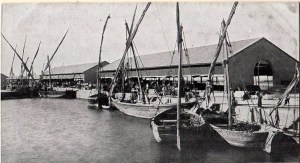
NativeJettyKarachi


KMC1950s


One hundred and sixty-four years ago the British decided to conquer Sindh. Rear Admiral Sir Frederick Maitland (who as captain of HMS Bellerephon in 1815 had the honour of transporting Napoleon Bonaparte to the remote island of St Helena) was ordered to land an invading force at Karachi.

He was aboard the flag ship, HMS Wellesley, built in Bombay. The fortress commander, the ‘Killardar’ of Manora, Wasul Ben Butcha, considered it beneath his Baloch pride to surrender. The Wellesley fired a broadside, the fort was smashed to smithereens, and the white flag was hoisted.

What did the unfortunate brave Wasul have on his side? If Sir Richard Burton is to be believed, his garrison was three-strong – an old man, a young woman and a boy. One gun had no carriage, another gun had been fired once and had jumped from its carriage – ‘which it had destroyed in its violent struggle for freedom’, and the third gun would not go off. (Hopefully, we are now better prepared.)

An agreement for the surrender of Karachi was signed by Maitland, and, as Behram Rustomjee (May 1912 – December 2002) writes in his book ‘Karachi’, : “Thus it was that Karachi came to be formally occupied by the British on 7th February 1839.”

Behli (as he was known) Rustomjee, who had graduated in London as a BE, was our English and modern history teacher at the Bai Virbaijee Soparivala Parsi High School in the mid-1930s. He rose to be principal and was at the BVS for over thirty years until he retired in 1965. How fortunate my generation was to have had teachers such as he and the great Shams-ul-ulema Dastur Dr Maneckji Nusserwanjee Dhalla (Ph.D, Columbia 1909) who taught us ancient history, the history of civilization and religion. Dr Maneck Bezonjee Pithawalla, a Doctor of Science, a Fellow of the Royal Geographical Society and also of the Geological Society, taught us geography and poetry. In fact, each could lecture on any subject.

Together with our academic learning, what was instilled into us was decency, tolerance, the spirit of ‘do as you would be done by’, the acceptance of the right of each man to his opinion, that religion is strictly between a man and his God and that it has nothing to do with politics or the state, that men of different faiths and beliefs can coexist, and that, above all, life is a gift from God to be lived and enjoyed to the full.

Behli gave me a copy of his book ‘Karachi (1839-1947)’ and in it he inscribed: “To a great-grandson of HJ from the author, a grandson of HJ. Let us work with unswerving faith on the future of Karachi, the city we both love.”

From the arrival of Sir Charles Napier in 1843 right up to the death of Mohammad Ali Jinnah in 1948 Karachi was a well-governed, tidy, clean and organized city. It was home to Hindus (of all castes and sorts), Muslims (Shias and Sunnis and all the other sects), Christians, Sikhs, Jains, Jews, Buddhists and Parsis who all coexisted amicably. And the same applied to the entire province of Sindh.

Behli wrote much on Napier, the first governor of Sindh, to whom the old and fine Karachi owes much. He tells us of the Italian marble obelisk erected in 1853 at what was later known as Napier Mole on which was inscribed the following words:

“From this spot on 1st October 1847 was fired the Farewell Salute to His Excellency Lt. General Sir Charles Napier, GCB, on his retirement from the Governorship of Sind, being the extreme point from which at that date a wheel carriage had ever passed along this Bunder, a work planned and executed under the government of His Excellency, and thus far completed at the date of his departure from this province.”

As says Behli, it was a befitting testimony to the planning and vision of Napier, to his extraordinary talent for civil administration, to his love for Karachi and to the care and attention he had accorded this then beautiful peaceful city. As he departed Karachi’s shores that morning on board the ‘Moozuffer’ bound for Suez, he exclaimed: “Thou shalt be the Glory of the East, would that I could come again to see you, Kurrachee, in your grandeur.”

Sir Charles Napier was ‘an old Peninsular Officer’ and the hero of the storming of the impregnable Imambargah fortress and of the victorious battles of Mianee and Dabo which rendered the province of Sindh unto the British Empire and gave rise to the story of the famous telegram he sent back to London which bore the sole word ‘Peccavi’.

He was 61 years of age in 1843 when he first came to Scinde (as it was then written). Slight and meagre of frame, scarred with the wounds of many battles, his conquest of our province was the culmination of his military career. He was appointed the first governor and commander of forces in Sindh by the governor-general, Lord Ellenborough. His first act was to move the centre of government from Hyderabad to Karachi, which for a sea power such as Britain could not have been a better choice.

Thus started the transformation of Karachi from a ‘miserable native fortress’ into a thriving port, a fortified town and a nerve centre for its new rulers. He built the finest barracks to house his soldiers (these magnificent buildings still stand and house the offices of the commander 5 corps and the Naval Comkar), whose welfare was his primary consideration, he set up for them a sanatorium at Gizree and Clifton, and laid out gardens and playgrounds. He planned the construction of Karachi harbour and its docks, he set up a timber pile pier at Keamari and built a causeway between that point and the city of Karachi, and he built the Manora lighthouse.

To ensure a sufficient supply of water he laid down plans: “The waters of the Muleer River were to be utilized not only for irrigating the government gardens for fountains but also for the houses of the town, the cantonment and even for the harbour of Keamari.”

Law and order being the first duty of any government, it was Napier who organized the police department of Sindh and Sir Bartle Frere commenting on it wrote: “His police system was, at the time he introduced it, far in advance of any other in India. It has been the model for most of what is good in subsequent reform of the Indian police.”

Security brought an increase in trade and business and industry and a growth in population. Merchants and cultivators came to settle and British and Parsi mercantile men turned their attention to Karachi which promised to be the ‘great emporium of trade with Central Asia’.

On August 10, 1847, for reasons of his own state of health and that of his family, Napier sent in his letter of resignation to the governor-general, who, in accepting it, recorded his regret at the loss of an officer “who combined rare abilities for the civil and military administration of the country, an ability which justifies the unlimited confidence.”

To revert to Behli’s inscription in his book, the HJ to whom he refers was Hormusjee Jamshedjee Rustomjee (1846-1899), grand seigneur, merchant prince, philanthropist and Grand Master of his Masonic Lodge, who lived and enjoyed his life in Karachi, and who ensured that many less endowed than he were also able to enjoy life. A marble tablet salvaged from the Masonic Lodge has inscribed on it: “This tablet has been erected by the Masonic Fraternity of Sind as a mark of the esteem and respect in which H.J. Rustomjee was held, for his sterling qualities both as a gentleman and a Mason.”

Our school, the BVS, founded in 1859 and nurtured by many an educated man of the community, enrolled only Parsis until 1948, when, on Jinnah’s request,
its doors were opened to admit boys of any faith, irrespective of caste or creed. In the year 2000, the government education division adjudged it to be ‘the best private boys’ school of Karachi, and it was awarded the Millennial Shield.

(Source: DAWN.com, Dated Feb 09, 2003)
Posted in Karachi History | Tagged , , | Leave a comment

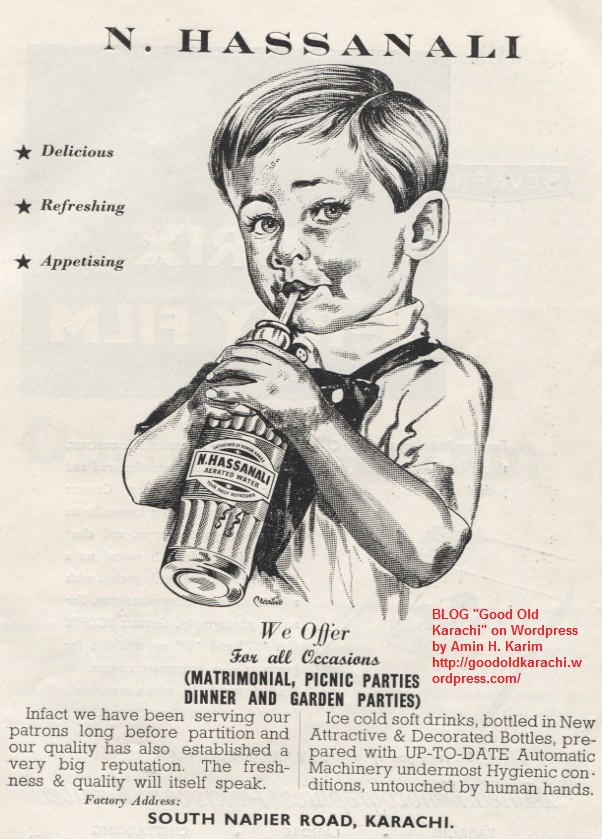
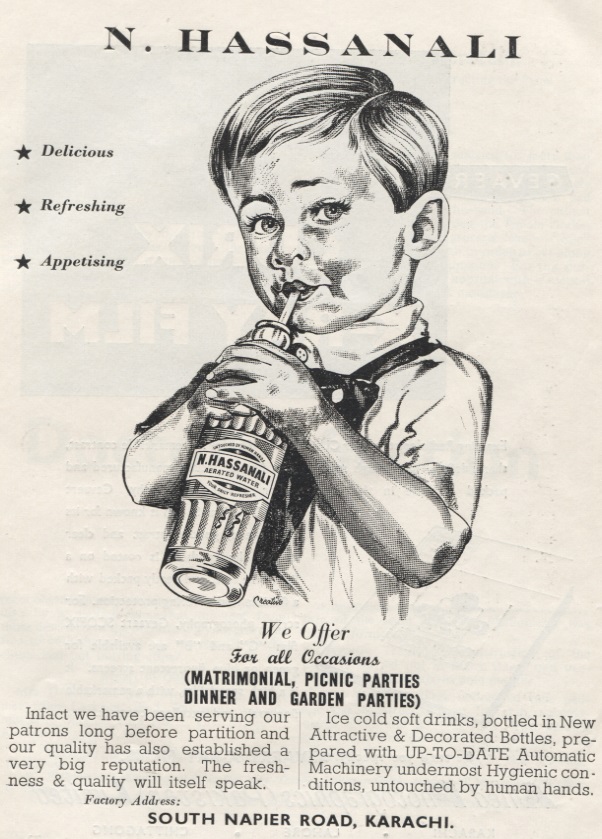
N. Hassanali – the softdrink with a Unique Name 1950’s

NHassanaliKarachiB

To see caption clearly please click on the photo

Regards
Amin H. Karim MD

Posted in Major Businesses in Old Karachi, Uncategorized | Leave a comment