By Raju Jamil
Live entertainment once nourished Karachiites and its nightlife was the envy of people from the rest of the country. The hotels dotted across the city were the hub of entertainment from the ‘50s to the early ‘70s. From providing live music shows and dance performances to hosting dance parties and serving as a rendezvous for people, the hotels of Karachi were the centre of attraction. Today, they are just a pleasant memory for those who were fortunate to have lived through the era. Kolachi takes a nostalgic look back this week at the city’s once-thriving hotel and nightclub scene.
Taj Hotel:
In 1942, a hotel by the name of Taj was constructed on the Club Road. In its first phase it served as a residential hotel. In its second phase, around 50 rooms were added. Notable personalities who resided at the Taj included Pakistan’s only Nobel Laureate, Abdus Salam and the Quaid-e-Azam’sBritish nurse. “Taj’s business slumped after the imposition of martial law in 1958, to revive the hotel, the Oasis nightclub was added in 1963,”shares its owner Venu Advani’. “It aimed at providing entertainment to male customers. Andaleeb was established for tourists and lovers of local culture, and the discotheque Playboy came much later in 1971”, he says.
Advani reminisces that performers from Europe often frequented Iran and Iraq via an agent in Beirut. So he visited Beirut to select and invite those dancers and musicians to perform at the Taj. However, their numbers were small due to the fact that only 50 per cent of their earnings could be remitted to their home country in line with the State Bank’s forex policy.
When the foreign minister of Ceylon (now Sri Lanka) Dharamcsec Senanyake visited Pakistan, the government officials showed him Moenjodaro and Taxila. He was soon invited by the Advani family to visit Andaleeb. The hospitality there was so cherished by him that the very next day he excused himself from a state appointment to visit Andaleeb again. “The foreign minister said he was bored of seeing dead places and the liveliness of Andaleeb was what he craved for,” recalls Mr Advani.
A programme by the name of ‘Karachi by Night’ was initiated by Advani to facilitate the tourists. There was no proper government authority working on promoting tourism at the time. ‘Karachi by Night’ was a night-long programme where the visitors were routed to various hotels and clubs such as Excelsior, Metropole and his own hotel Taj. In 1977, prohibition led to the shutdown of all bars and nightclubs. And the martial law that followed ensured that the entertainment came to a standstill. In 1981, Taj Hotel disappeared altogether.
The Palace Hotel:
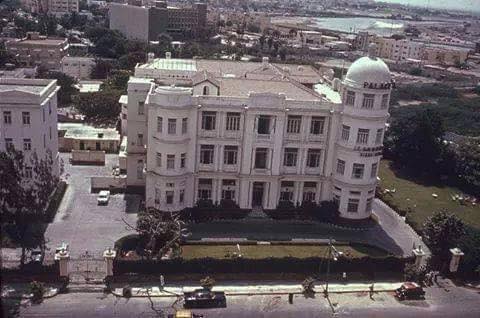
1940s: Aerial View of Killarney hotel (later Palace Hotel), then Sheraton Hotel and now Moevenpick Hotel – Karachi
Location by number(s):
1. Karachi Gymkhana Cricket Ground where the unofficial Pakistan v/s MCC match took place in 1952.
2. Where we now have Pearl Continental Hotel.
3. Where we now have PIDC Building since 1956.
4. Dr. Ziauddin Road.
5. Polo Ground…opp: Jinnah Courts.
An eminent philanthropist, Ardeshir Mama, built a home to accommodate his 21 children which was famously called Mama’s Mansion. The building was constructed soon after the First World War. It is said that a small bistro was established by Mama. However, when he ran into debt, the property was forfeited to the Punjab government. In the early 1930s, Sidney Marder, a European Jewish Karachiite bought the place and relocated his hotel Killarney to Mama’s Mansion and renamed it as ‘Killarney Hotel- Marder’s Palace’. Killarney was used extensively as lodging for US officers. The hotel ran well till after the World War II. Marder sold the property sometime in 1946-47 and left the country. Mr Advani states the Singhs of Calcutta ran the hotel. It is possible that Sidney Marder sold it to them. In the years that followed, it simply became the Palace. “After partition, the Indians were allowed to maintain private properties in Pakistan”. In 1967, the government took over the Palace and it was sold to the Ramchandani family who operated it till it was bought by Sadruddin Ghanji,” shares Advani. Ghanji demolished the old structure and built the current Hotel Sheraton on its grave.
Pictures from the period show that the name of the hotel was written as a neon sign on its dome. In other pictures, the name was seen affixed to the rooftop. The hotel held an important place in the social life of the city. The Palace Hotel, from 1948 to 1953 was the residential enclave of foreign diplomats. The Palace also attracted a regular crowd of intellectuals soon after partition. It is said thatFaiz Ahmed Faiz would be a part of those gatherings dwhenever he passed through the city.
Since nightclubs were very popular and socially acceptable back then, the Palace too housed such a facility by the name of Le Gourmet. The main attraction at Le Gourmet were the jazz musicians from abroad, although many old-timers have doubted this fact. Local Jazz musicians such as the Franciscoband also performed at the Palace in the late ‘50s and early ‘60s. The famous cabaret dancer of yesteryear, Marzi Kanga, also performed at Le Gourmet. After such venues were shut down, Kanga went abroad to perform at international hotspots.
Metropole Hotel:
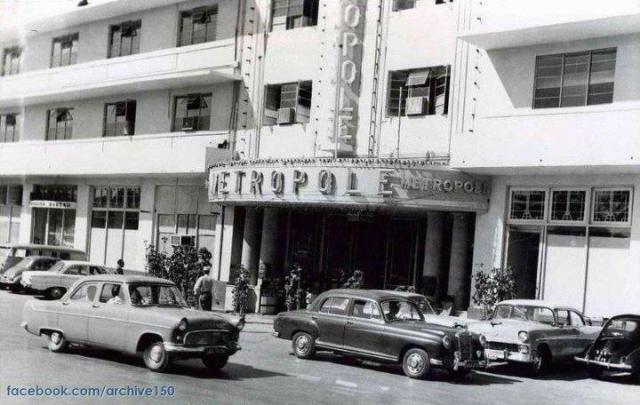
One hotel that survived till more recently was the Metropole, whose building still stands as a city landmark despite talk of its demolition. It has a special place in the hearts of the city. It was established by Cyrus. F. Minwalla, the then vice-president of the Karachi Cantonment Board. In 1951, it was inaugurated by the Shah of Iran. Initially, it housed two floors but later other floors were constructed. From 1953 to 1964, it served the city with an inimitable flair. As one entered the hotel, there was a coffee shop that was a daily rendezvous for senior and city journalists. The juniors would hang around to eavesdrop. A cup of coffee cost two rupees, which was a heavy sum back then. On Sundays, a special Parsi menu was served with Dhansak the most popular dish.
The legendary jazz musician, Dizzie Gillespie, who visited Karachi in the 1950s (most likely 1954), performed in the garden of the Metropole. The Meridian international center website states that he refused to play until the doors were open to the ‘ragamuffin children’ because the tickets were so expensive that the people with whom the musician wanted to connect couldn’t make it. The garden could accommodate up to 4,000 people.
The hotel also served as a host for many state functions. In the mid-1950s, the Ismaili community requested a suite to be prepared for His Highness the former Aga Khan. The Pak-American Cultural Centre regularly held events and the French ran an opera at the Metropole. “In 1964, the opening of the Inter-Continental proved to be a blow for Metropole as the customers were attracted to the new place,” claims Happy Minwalla, who owns the building along with his sisters. Metropole continued to operate and thought of innovative ways to pull in an audience. “In 1967, we introduced our discotheque- the first in the city”, says Mr Minwalla. Local bands of the city, such as the Incrowdperformed at the discotheque. In 1968, the famous Samar nightclub was built. Samar had live orchestra from abroad, be it Italian or Filipino. Local bands also performed, one of them was theCaptivators. Marzi Kanga also gave enchanting performances at Samar. The beautiful dancer Amy Minwalla, who often danced in films also held shows at the Metropole, where people recall her performing ballet including some international dancers.
Professional belly dancers were a norm, with Princess Amina from Beirut being the most popular. Cultural events such as plays and the Berlin Orchestra conducted by also took place. “Christmas and New Year parties were a rage back then. Even Valentine’s Day was celebrated with a ball being held,” says Minwalla. “The hotel looked for any cause for celebration, be it the fourth of July, theme based events such as Middle-Eastern or Mediterranean nights or Italy’s Independence Day, where exclusive Italian cuisine was served”. Minwalla added that 2,500 marriages have taken place at the Metropole. “In 1967-68, Z.A. Bhutto held the launch of his party, the Pakistan People’s Party, at the Banquet Hall of the Metropole,’’ recalled Mr Minwalla with pride and nostalgia.
Sections of building were rented out to offices in the late 1970s. The prohibition hurt Metropole, which closed Samar and the discotheque. The Zia era ensured that dance and mixed- gatherings were not promoted in any way. Even food quantity was restricted, further hurting Metropole. The hotel continued to serve as a residential and catering facility but the old charm was gone. In 2004, the owners decided to demolish the building and construct a high-rise hotel. When a section was demolished, it agitated the conservationists, who then got the building declared a heritage site and barred it from being demolished. A court will now decide the fate of it.
Hotel Grand
“In 1937, my parents bought an old farmhouse in Malir,” reminisces Minwalla. “During the war, the U.S. soldiers needed to pitch tents. The farm land was leased out. My father ran the bar and my mother ran the kitchen. In the process, Hotel Grand was born. Since it was close to the airport, it was a popular destination for those visiting the airport. Many airlines such as Pan American housed its crew at the Grand. The Olympic-sized swimming pool pulled in many customers. Back in those days, a drive to Malir was quite exciting as there was no Sharea Faisal to take one to Malir,” shares Happy Minwalla. In 1972, the Minwallas closed the hotel and sold the building.
There was also an Imperial Hotel on Queens’s road. It ran the Lido bar. It is said that it was usually preferred by people with more modest incomes. Further up the road is the Beach Luxury, also once a major hub of nightlife housing the Kasbah and 007, which had managed to survive.
The Railway hotels
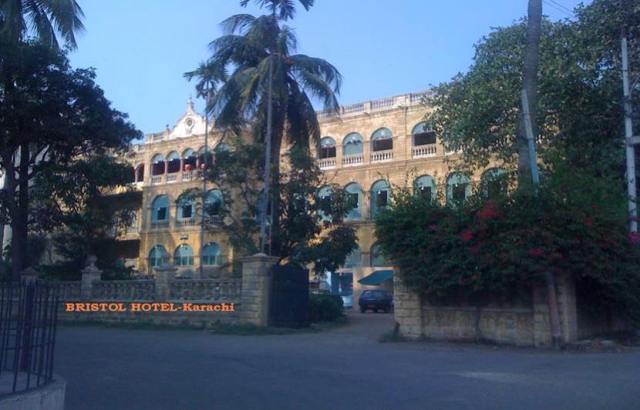
Apart from these hotels, the citizens were also catered to by four railway hotels – the Carlton, North Western, Bristol and Killarney, all fairly near the Cantt station. While there are many accounts regarding the construction and ownership of the Bristol, Byram Avari, owner of the Beach Luxuryand Avari Towers, maintains that it was constructed by a Hindu gentleman and operated by an English Jew, Mr Wiseman. “The official rules stated that no Indian, regardless of faith, could run an ‘English style hotel’, In 1944, Mr Wiseman left the country and sold the property to Avari’s parents, Dinshaw. B Avari and Khorsheed Avari, who had to make special requests to the Commisioner, Sir Sidney Ridley, to purchase the hotel and run it. “They were granted the permission on certain conditions which included serving only chicken at lunch and dinner given the high price of beef”, recalls Avari. They ran the Bristol for 11 years. “After partition, the hotel saw its business boom as Karachi became the capital city and destination for foreign diplomats,” narrates Avari.
Initially, the hotel had been a simple eatery for the army officers and affluent. “We maintained an in-house band and dance parties for New Year and Christmas used to take place,” shares Avari. In 1955, the Dinshaws bought the Bristol, from whom it was sold to Mr Rizvi, an income tax officer. Despite changing hands, Bristol’s bar and cuisine were maintained. In 1960s, the price for a couple’s ticket to a New Year’s party was Rs 300! Later on, shows such as Saturday Night Disco andNightclub were introduced, where groups from Thailand, Germany and France performed. In 1961, Hollywood actress Donna Reid rested at the Bristol when she had an overnight stay in Karachi en-route to Cairo. In 1994, the hotel suffered two subsequent attacks leaving Mr Rizvi injured. The hotel shut down. The building still stands and is often used for shooting drama serials.
Killarney was owned by Sidney Marder. In 1930s, the hotel relocated to the Palace. It served as a Russian consulate for years. Currently, it is being used by Bayview High School.
�North Western was constructed in 1908. “It was owned by a Jewish family, the Wyse, who were from Austria, they sold it to my father, Agha Mohd Yusuf sometime in 1946, as they were migrating to South Africa”, informs Hissam Yousuf. It housed Agha’s Tavern, which served continental cuisine, and Agha’s Grill, which served Pakistani delicacies. Entertainment was not offered as such but Christmas and New Year were celebrated with fervour. Then came the dark ages and prohibition affected the hotel. In 1985, the family decided to shut down the hotel for renovation and repair of the building. Later, it was sold to private developers. The building stayed vacant till early 1990s, when it was demolished along with Carlton, while in process of being listed as world heritage sites.
Best Western Plaza
The Best Western Plaza opened on Daudpota Road sometime in the late ‘70s and early ‘80s. Its construction continued till after its opening. It had 14 storeys. The 14th floor housed a disco, which continued to operate in Zia’s time, till his moral police came across it. It was used as a backdrop in many Pakistani films. An open air theatre was used for Qawwali and poetry recitation. During Badar Mir’s recital, the gates were nearly broken down due to the heavy crowd. The hotel also hostedMohammed Ali and Madam Nur Jehan’s programmes.
Moreover, The Beijing Dragon Palace had one of the finest Chinese restaurants of its time and that too with local chefs. A section of the hotel, such as the Irma coffee shop and the Hamza conference hall amongst others, were named after family members of the owner.
The family maintains that Indian stars such as Vinod Khanna, Rekha and Dilip Kumar also resided at their hotel. In 1990s, the family ran into a financial crisis and leased the hotel to someone with strong political connections. The hotel was subsequently found guilty of allowing prostitution to thrive on its premises, leading to a raid. Subsequently, the hotel was shut down in 2000.
Hotels are on the hit-list and unable to offer much for entertainment. Besides society has become more conservative and many equate music and dance with vulgarity and sin. However, Karachiites crave for affordable entertainment and hotels even today to bring back some of the nightlife of the past. If cinemas are seeing a revival, why not entertainment at hotels too?
My Band Experiences in Karachi ~ Donald D’silva
In 1958, I moved to F.C.C.H.S. I grew up with all the guys in the block. We had great times together, playing all the fun games together, doing things which would upset the elders, but those experiences I remember vividly and will always cherish them.
I was relatively shy in high school and a little beyond, but with my experiences playing in the band, things changed for the better. I was bad but not terribly bad.
My interest in music started at an early age. My mother and some of her siblings played the piano and we would have great party sing-a-longs for all family occasions. My dad’s mother, Aunty Virgie, was an accomplished pianist and used to teach piano. I was forced to go to her for piano lessons, but I did not get far as I was more interested in playing with all the block boys.�I joined the St. Patrick’s school band in the early sixties and used to play the clarinet. I also learned how to play the harmonica. When we were in school, I learnt the guitar. I did not have a guitar, but with the good friends who had a guitar, like Everard Remedios, the late Johnny Aranjo and others, I managed to get pretty good on the guitar.
I am also indebted to a good friend of mine, Titus Nunes. I used to go his house in D’Cruz Lane and would get the opportunity to listen to some of the new music, practice the guitar and fool around singing.�In 1969, we started practicing as a group i.e. Titus Nunes, Willie Po, Peter Patrick, Iggy Castellinoand I. We practiced in Iggy Castellino’s spare house, which we called the “Shack”.
In late 1969, we got an opportunity to play at “The Merchant Navy”. This was a joint adjacent to The Beach Luxury Hotel, patronized by the shippies. There was very little pay but this was considered to be the training grounds for musicians. I am greatly indebted to Peter Patrick, who loaned me an electric guitar so that I could be part of the group.
We, like many other musicians will always be thankful to a gentleman named Schwartz, who had a shop in Regal and would rent out amplifiers and PA systems to the Karachi musicians who could not afford to buy the stuff. We named our group Barbed Wire and sometimes we were Willie and the Po boys. I played the lead guitar and sang. This stint lasted for about a year, and ended when the 1971 war with India started.�After that, I completed my B. Comm and started working. There was no music for me until the end of 1972, when I was approached by Titus Nunes, the late Edgar Saville who asked me if I was interested in joining a group, namely “The In-Crowd”.
The In-Crowd was a very famous and well recognized group in the sixties and into the early seventies. I agreed to join, this time playing bass guitar and vocals. There was only one member of the original In-Crowd remaining, Edgar Saville.
This lineup comprised of Ronnie Pinto (lead and vocals), Hilary Fialho (drums). Titus Nunes (rhythm guitar and vocals), the late Edgar Saville (keyboard). After loads of practice and getting our act together, we turned out to be a good group and I believe kept the name of the In-Crowd in good standing.�Edgar Saville was just brilliant with his musical abilities. I learned a lot from him and also from Ronnie boy, who was a very progressive musician. We continued playing at the Disco in Hotel Metropole and had some great times. We continued at the Disco till it closed in the latter part of 1974.
We then moved to the Beach Luxury Hotel where we played at “Casbah.” I played for a few months at the Beach Luxury but for personal reasons, quit the group. I was replaced by David Fredrick andTitus took over playing bass.
I then joined a Chartered Accountant firm, Ford Rhodes Robson Morrow with the aspiration of doing my CA (a dream). The stipend paid for this stint was rupees 75.00 a month. I continued with this job until I was approached by Titus Nunes, Hilary Fialho, Ronnie Pinto (from the In-Crowd) and Clarrie Andrade and Alex Gomes (from the Phase – II, who played at the Midway House). These individuals were in the process of quitting their respective groups due to differences. I was asked to join the group as a singer, something I was not comfortable doing as I always had a guitar in my hand. Anyway, they coaxed me in to joining this six piece group which was name, “The Familiar Faces”.�The Familiar Faces did not need much practice as all the guys, except myself were still playing, although I had a little catching up to do. In the first half of 1975, we landed a very lucrative contract at the Hotel Intercontinental (The Nasreen Room). This was a very sophisticated joint, patronized mainly by the rich and famous. Playing at the Nasreen Room was a great experience, both from the satisfaction of the music played and the appreciation from the patrons. There were changes in the group, when Clarrie Andrade and Ronnie Pinto had to quit the group when they migrated to Canada. Michael Rodrigues (keyboard) and the late, great Ivan Menezes joined the group.
We continued until early 1977, when due to personal reasons, Michael, Ivan and myself left the group. A few weeks later, the three of us along with Tony Fernandes aka Tom Jones (drums), formed a group which we named “Schwartz”, honouring the great creator of amplifiers and PA systems.
We played mainly for weddings and were having great deal of success when the unthinkable happened. We were scheduled to play for a wedding in the evening, when in the afternoon, Ivan Menezes was killed in a motorcycle accident. That was devastating and his loss was greatly felt.
My final band experience was when, Norman Fernandes, Sidney Fernandes, Edgar Saville, Ronnie Remedios and myself formed a group and played at “The Midway House”.
At the end of 1977, Ronnie Remedios and myself quit the group and that was the end of my official playing experience.
My last unofficial band experience was when I was asked to help the Blackjacks, who at that time had Roland Trinidad, Glenn Boyle, Ronnie Remedios, Michael Rodrigues and Bobby Fredrick, who were playing at the Three Aces. I was now working full time at SAS, a great job and free airline travel. As their main vocalist, Bobby Fredrick left the group, I was asked to help with the vocals until they could get things together. I stayed for a short time with the Blackjacks and did some singing, until Trevor D’Mello was ready to take over with singing and his saxophone.
Thus ended my band playing experiences and I can sincerely say, I would never trade this great experience for anything else. It allowed me become a self confident person and has left me with memories that I will cherish forever.
——————————————————————————
Editor’s note:
Donald & Marie Therese live in Toronto, Canada
Looking at the 1973 above photograph, the person on the left is the late Edgar Saville (keyboard), 2nd from the left is Titus Nunes (rhythm guitar and vocals), in the middle is Hilary Fialho (drums), 2nd from the right is Donald D’Silva (bass guitar and vocals) and on the extreme right is Ronnie Pinto (lead guitar and vocals).
BRISTOL HOTEL – KARACHI
(1910-1994)
BRISTOL HOTEL Karchi was constructed by a Welshmen (name unknown) in 1910
near the Cantonment Railway Station-Karachi..parallel to the rail tracks between
Karachi Cantt and Karachi City Railway Station. It neighbors the British Council now.
Initially a TAVERN & BISTRO for the affluent ones..mostly the high echelons and army
officials under the British Raj of early 1900s.
The hotel was mostly the venue of the most talked about New Year parties, May Queen Ball and wedding parties and became the most popular place of Kolachi or Kurracchee then which continued till late 50’s when the Welshmen’s son Grout, left for UK selling it to a Pakistani namely Rizvi Sahab, an I.T.O in 1960.
Karachi—in 60’s had hardly a few hotels..and the ones I remember, which were worth
a stay; Metropole, Palace, Beach Luxury, Grand, Excelsior, Taj…with Intercontinental (now PC)
the first 5 star in city…commencing its operations from 2nd May-1961 with Bernard Holt as it’s first ever GM !
Mr. Rizvi maintained the grandeur of BRISTOL and it’s BAR and …
particularly it’s cuisine which was, probably
the best in Karachi and could not be beaten by the food served at the restaurants
of Metropole, Palace (where now stands Sheraton) and Agha’s Tavern (which
use to be right behind Palace Hotel Annexe—bang opposite it’s hotel where the
dilapidated building looks a haunted one now..adjacent to the PIDC building
towards Chief Minister Sindh’s House.
People traveled from far and wide—to enjoy the cuisine at BRISTOL.
The New Year Parties and May Queen Ball continued with the same fervor and glamour.
During 60’s the price tag of NYP entry for a couple was Rs.300 (close to Rs.15k of today).
The scribe has attended two new year GTs at Bristol in 1968 and 1969. Rizvi Uncle
being my dad’s colleague—and a close friend—was like a family. His brother, then,
was one of the famous doctors of Karachi; Aaley Zamin Rizvi. He had a clinic near Regal Cinema-Karachi.
BRISTOL continued to attract affluent Karachi-ites for it’s cuisine basically while
the huge rooms with roushandaans and the lush green garden with Saturday
Night Discos and Night Club was par excellence…where groups from Thailand,
Germany and France were in attendance which was adopted by the Minwallas
of Metropole for their ever popular SAMAR night club and dine out of the 70’s.. on the
ground floor entrance facing Café Grand…where we also had UBL Hotel
Metropole Branch on the left side and the famous travel agency GERRYs on the right.
BRISTOL Hotel breathed it’s last when it was attacked by some dacoits
and Mr. Rizvi suffering injuries in 1994 which re-occurred within six months
that Rizvi Sahab was kind of forced to call it quits.
BUT…the building of BRISTOL hotel..a landmark and solid construction of 1910
still stands tall..as a home now.
It is said that American movie star—DONNA REED has stayed at BRISTOL
sometime in 1961 during her overnight visit to Karachi enroute to Cairo
on the arrangement by PAN AMERICAN airlines which used to house
it’s crew at Malir’s GRAND Hotel of Minwallas, near Karachi Stargate Airport of 1935.
It was after 3 decades that I visited BRISTOL HOTEL for recording of
Adnan Wai Qureshi’s serial in 2012 and a lot of golden memories wreaked out which I thought to share with you all
(Raju Jamil)
(On Bristol Hotel only)
Rest is snagged and sharing
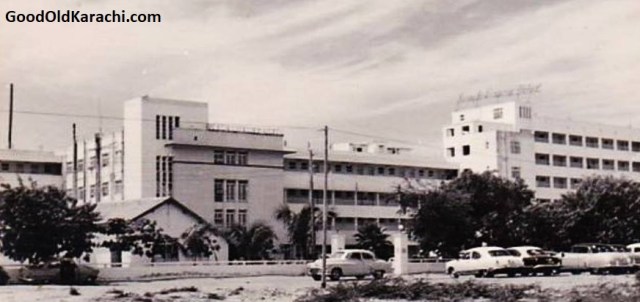
Beach Luxury Hotel, Karachi.





 Good Old Karachi