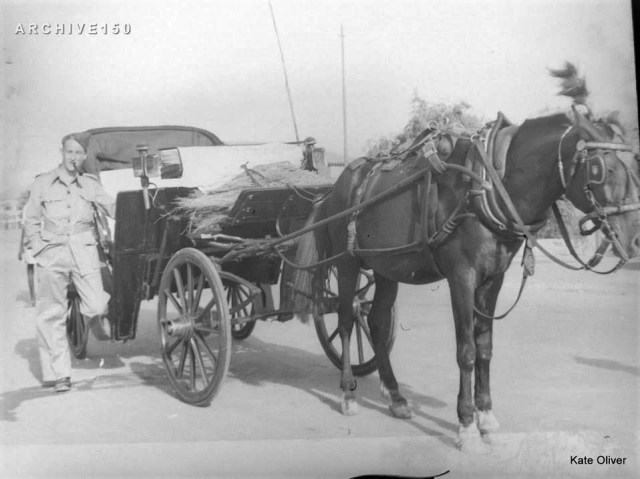
Imperial Airways Limited 1924

By 
Dr. Sohail Ansari 


AnsariSohail2018

ImperialAirways1924

30th March  1924 marked an unforgettable event in the history of aviation for Karachi.

Imperial Airways Limited which was formed on 31 March 1924 with the merger of British Marine Air  Navigation Company Ltd, the Daimler Airway, Handley Page Transport Ltd and the Instone Air Line  Ltd. started the London to Karachi air service on 30 March 1929. The journey took mere 7 days and  consisted of a flight from London to Basle, a train to Genoa and a Short S.8 Calcutta flying  boats to Alexandria, a train to Cairo and finally a DH.66 flight to Karachi.

Posted in Transportation in Karachi | 2 Comments

Begum Naheed Iskander Mirza

By 
Amin H. Karim 

MirzaIskanderNaheedMirzaNaheedIndustrialDesign1957

June 15 1957; Begum Naheed Iskander Mirza inaugurating the symposium of Pakistan Institute of Industrial Design in Karachi. Photo source unknown:

Syed Ahmed wrote: (on FaceBook post July 2019) “Just imagine, we had an Institute of Industrial Design way back in ’57. We were way ahead of the rest of Asia, especially South East & North East Asia. Korea had just come out of the war. Vietnam was enmeshed in it and will remain so. China was one huge village with manual cooperative farming. Singapore was a backwater. Thailand was a fleshpot. And look where we are now. The others have leap frogged over us

Mirzanaheed1956Dow

At Dow Medical College, Karachi.


Posted in Karachi History | Leave a comment

Avtar Kishan Hangal

By 

Dr. Sohail Ansari 
AnsariSohail2016
‘Itna sannata kyu hai bhai?’
Avtar Kishan Hangal
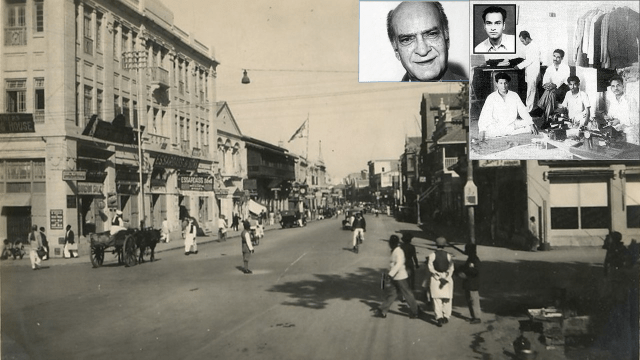
On arrival to Karachi in 1939, twenty five year old A K Hangal was received by Brij, his brother in law who lived with his Muslim wife and family in a spacious apartment located in the then fashionable Preedy Street. Hangal rented a shop on Elphinstone Street to commence tailoring. However, the business did not work well and he had to shut it down. Soon, he found a position of cutter in a well known cloth and tailoring store, ‘Essardass and Sons’. I recently shared a photograph of Elphinstone Street in which this store can be seen on the left side, third door with a large sign board. He became friends with its owner.
Once settled, Hangal founded ‘The Harmonica Club’ to whet his appetite for music and drama and it became very famous.
He initially was a Congress worker, but by 1941 changed to join the Communist Party of India and worked for All India Trade Union Congress. The workers in tailoring shops were exploited and despite the Shops and Establishment Act denied due rights. Karachi Tailoring Workers’ Union was established of which he was elected the first President. Consequently, in view of those trade union activities creating conflict with the employer, he was dismissed from the job and no other tailoring business was ready to hire him.
He led a general strike in support of the Indian Navy Mutiny of 1946 and narrowly escaped the firing. He became the Secretary of Karachi Communist Party in 1946.
On 12th August 1947, he was approached to record and broadcast a play within 48 hours for radio station in Karachi in a make shift tent on the occasion of Independence on 14th August.
Following creation of Pakistan, the government came hard on the communists and A K Hangal was among those arrested. He was sent to the Central Jail.
One day the Superintendent of the Karachi Jail told him that he will be transferred to India being a non Muslim detainee. He put a petition against the transfer to India which was accepted but the prison sentence was increased.
His case was contested in the Sindh High Court with the help of Comrade Sobho Gianchandani and a four-lawyer team including Sheikh Ayaz.
While serving time in Karachi he was transferred to the Hyderabad Central Jail. In the end, very soon thereafter, he was forced to leave Pakistan and went to India in 1949. Hangal could have stayed in Karachi if his wishes were respected.
In India, he acted in around 225 films and I recall him well from his role of Rahim Chacha in Sholay. He had financial difficulties and health problems and could not afford the treatment. As well, he withstood the Shiv Sena onslaught for his political and socialist activism.
He died seven years ago in a hospital in Bombay, aged 98, on 26th August 2012.
HangalAvtar
(In this photograph of Elphinstone Street is seen this store on the left side, third door with a large sign board. In the inlet he is seen in the store with co-workers).
Posted in Contributions by Hindus | 1 Comment

A Ship Called Dwarka

SS Dwarka owned by P and O Steamship Company served the route between Kuwait and Bombay stopping at Karachi harbor on the way. It took workers from Kerala to the Gulf and back,. “Deck with food’ in 1982 cost Rs. 1100 per trip. In 1960s the cost was Rs. 45 per trip. Mohammadi Steamship Co. were the agents in Karachi.

Other ships belonging to the same company were Dara (which caught fire and drowned in Dubai), Dumra, Sirdhana and Sinthia. Another company Scindia owed Sabarmati and Saraswati plying between Karachi and Bombay.

Dwarka made her final journey in 1982 and was dismantled at Gadani on Makran Coast west of Karachi. May she rest in Peace! (AHK June 24 2019)


Image may contain: sky, ocean, outdoor and water
Posted in Transportation in Karachi | 1 Comment

Darya Lal Sankat Mochan Mandir Karachi


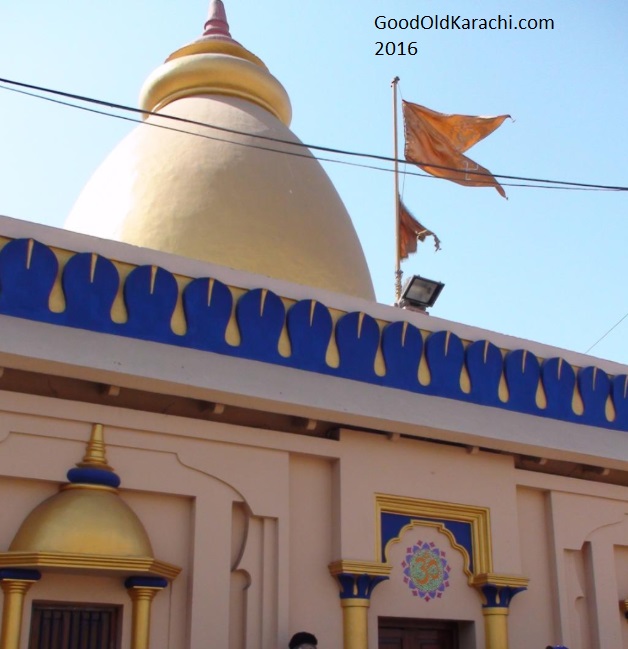
Darya Lal Sankat Mochan Mandir (also called Jhoolay Lal Mandir), It is located on Eduljee Dinshaw Road near KPT Custom House – Karachi Darya Lal Mandir got its name as it is situated just on the edge of the Arabian sea. The story goes that the Hindus living in the areas around this temple sought the blessing of the deity in the sanctum sanctorum before launching their boats in the sea. It is believed that those who sought the blessings, were safe and sound no matter whatever the fury of the tempest used to be. Apart from that they also got the best variety of fish. Basically most of them came from Mohalla Mahigir (fishermen’s locality). Today, they prefer to make their journey without Darya Lal’s blessings, perhaps because a large part of the temple as well as the surrounding area has been encroached upon by the Karachi Hazara Goods Company, transporters and a tea canteen. (Source Wikimapia) 

DaryaLalSankatMochanMandirKarachi2016

Posted in Contributions by Hindus, Historic Buildings of Old Karachi | Leave a comment

Seth Ahmed Dawood

Seth Ahmed Dawood

By
Aminurrehman Chaudhry 

Seth Ahmad Dawood, one of the pioneering industrialists of Pakistan

He led a long eventful life and saw many ups and downs in his business. Yusuf Shirazi, a well-known entrepreneur with business interest in diverse fields, call Mr Ahmad Dawood “a visionary rather than a business manager.” He recalls Mr Ahmad Dawood telling him that his job was “to conceive and set up the project.” The running and management of the projects was the job that was left to his brothers and his sons. “He had the knack of conceiving high-tech and capital-intensive projects and all profitable,” Mr Shirazi said.

Mr Ahmad, son of Dawood, was born in Bantva, a small sleepy town in Kathiawar. His father was a trader. Mr Ahmad found Bantva too small for his business acumen and migrated to Bombay. Just before Independence, Mr Ahmad Dawood had established a trading house dealing in commodities, textiles, jute and yarn, with branches in many cities and towns in pre-partition India.

“He was commanded by Quaid-i-Azam Mohammad Ali Jinnah to migrate to Pakistan and set up an industry,” Meher Alavi, a former President of the Federation of Pakistan Chambers of Commerce and Industry, said.

With Adamjees and Valikas, Dawoods played the pioneering role in late forties and early fifties to create a business culture in what was then West Pakistan. Dawood Cotton Mills, an integrated textile project in 1951, must have been a dream in 1947. Karnaphuli Paper Mills was set up in East Pakistan by the EPIDC but acquired by Dawood who transformed it into a vibrant industrial unit. It met the newsprint requirements of the country before separation of the East Pakistan in 1971.

Separation of East Pakistan in 1971, massive nationalization in 1972 which took away life insurance and petroleum business and finally a split in the family, gave one after other setbacks to the business of Mr Ahmad Dawood.

Dawoods played a leading role in the public welfare. Dawood Foundation was set up in 1961 with a capital of Rs25 million. Dawood Engineering College was set up in sixties which was later nationalized. It is still a leading institution of technical education.

Image may contain: 1 person, standing and indoor
Image may contain: 4 people
Posted in Contributions by Muslims | Leave a comment

The Salt Works of Mauripur

By 
Dr. Sohail Ansari


AnsariSohail2016

MauripurSaltWorks

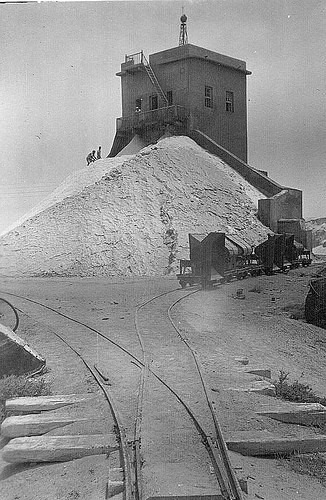
Most people associate Mauripur with an airbase but salt works is another reason for its fame. It was named after Mr Mauri, the first Salt Revenue Officer who knew the industry well. Some sources quote him as an expert on salt who established the first salt pens of Karachi. The salt works were opened in Mauripur in 1878. The British rulers awarded over 500 acres of land for the salt industry. Nearly 175 acres of land were subdivided into small plots. The area was considered to be isolated in those days. Grax salt works, Lakshmi salt and Nusserwanji salt were the main players during the later British era.

After 1843, British rulers offered the land to their supporters of Sindh near Mauripur. But they rejected the offer thinking they will not be able to survive in the isolated area. Then the British officials extended the same offer to Noonari families, who lived and collected salt there. Just remember that these are not salt mines but it is produced with other techniques. Salt was processed through the spread via evaporation and then heaped into mounds in that era. Salt pans with 8-foot embankment as protection against the high tides are seen here. The tide waters rose and fell alternatively in this area. The brine was brought up from the wells, sunk alongside the pans, and allowed to be evaporated. The salt was scrapped with wooden scrapers, was washed by salt water from the wells and then stored in conical heaps. I do not know how do they do it now. I read somewhere that an estimated approximately 20,000 tons of salt is produced here every month, with an average monthly turnover of Rs 6 million. Some 250 workers earn a livelihood in this area; and these were the figures from 2004. The salt works were developed to meet the industrial and domestic requirements of growing city. In 1940’s large quantities of this salt was sent to Bengal. The main buyers in the recent years have basically been the local traders who grind the salt to sell it in small packs to food industries. Taxation of salt in India occurred very long ago. It was greatly increased when the East India Company came in.

The stringent salt taxes imposed by the British were vehemently condemned by the Indians and ultimately resulted in Mahatma Gandhi’s Salt Satyagraha in 1930. A news report from April 1930 was: ‘FIERCE rioting broke out at Karachi during the trial of six Nationalists and leaders of the Indian Congress party for violation of the Indian salt laws. A mob of 10,000 people, of whom the majority were members of the Workers’ Unions and students, besieged the court, smashed all the windows with stones, broke through the police cordon, and wrecked the courtroom and offices. The mob then attacked motor cars and trams, and stoned the occupants, many of whom they injured. The police made numerous baton charges without effect, and eventually opened fire, wounding nine, of whom one died later. The crowd still refused to disperse, and British troops were called out, and order was restored. Twenty six persons were injured in the baton charges and by stones. There is a general strike of scavengers, and dock-workers, as a protest against the trial of their leaders.’
Posted in Karachi History | Leave a comment

Portrait of the Quaid

By Menin Rodrigues

RodriguesMenin2018Small

QuaidAuthenticPhotoMenin
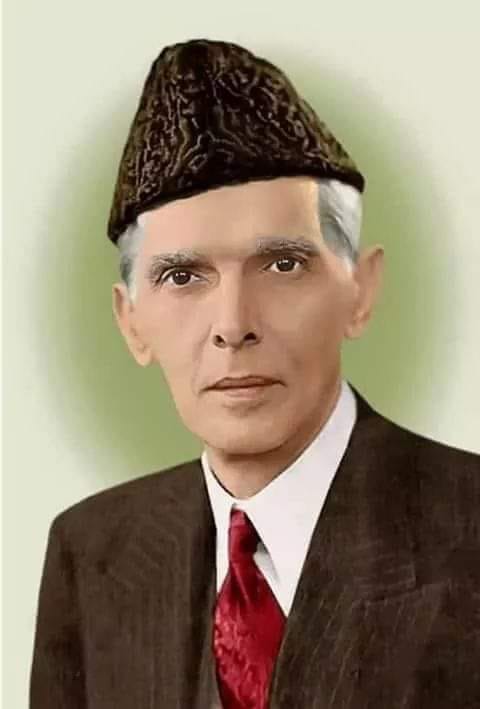
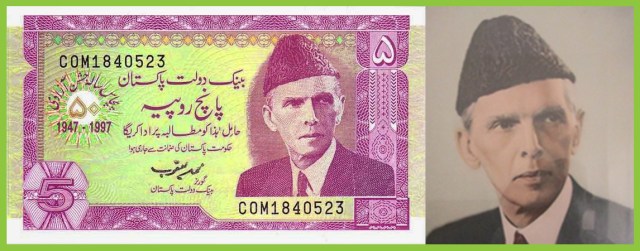
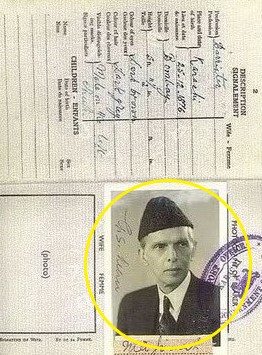
The portrait on top was taken by Mr. Arthur Sequeira in the studios of Messrs. I. Sequeira & Sons in Saddar Karachi (where the Atrium Mall stands today) in 1943. It was a black & white photo, colored by studio artists to show his actual attire when he came to the studios for his “Official” (see his first passport) photograph. It was also used on all our currency notes and in government offices. Unfortunately, there are so many variations now, not one of them original; WHY do we do this, distort history?
QuaideAzamPortrait
This photo is not the authentic one.
Here are comparisons of 2 more phases in our history when sanity prevailed:

Pak Currency Note - Urdu & Bengali + Original (1)

Pak Currency Note - 1947 to 1997 + Original

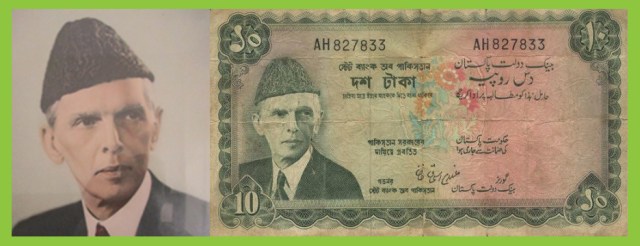
Image # 1 – Before 1971 when ‘Bengali’ was also inscribed on our currency notes (the QA image as in original)
Image # 2 – On the occasion of the nation’s 50th Anniversary/Golden Jubilee (1947-1997) – (the QA image as in original)
Distortion on Currency Notes
After 1997, the image was modified/altered for the QA to be shown as wearing a sherwani.

Jinnah's PassportRa'ana Liaquat & I. Sequeira family

Begum Ra’ana Liaquat Ali Khan inaugurating the official photograph of Mr. Mohamed Alibhai Jinnah in the presence of the family of Messrs. I. Sequeira & Sons Photographers, Karachi, where Mr. Jinnah came to take his photograph.
May be an image of 8 people and text that says 'Official Portrait MOHAMED ALI JINNAH- 1945 ED1S MR LOHE Mr. Arthur Sequeira Photographer, Sequeira Sons, Karachi. Exposed the Official Portrait Mr. Mohamed Jinnah 1945 COM1840523 MR-ARCHIVE 2013'
Posted in Contributions by Christians, Karachi History | Leave a comment

Animal Drawn Carriages

Photos collected by Menin Rodrigues

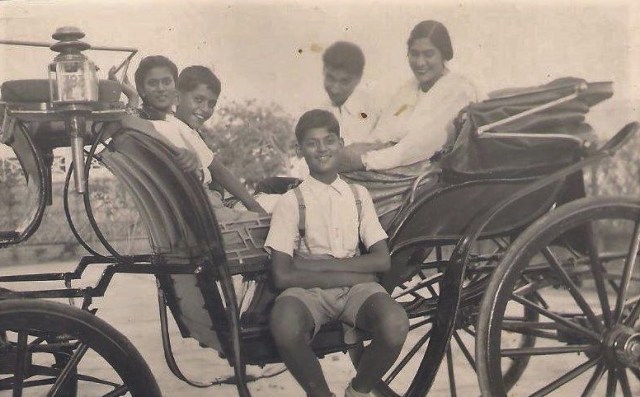
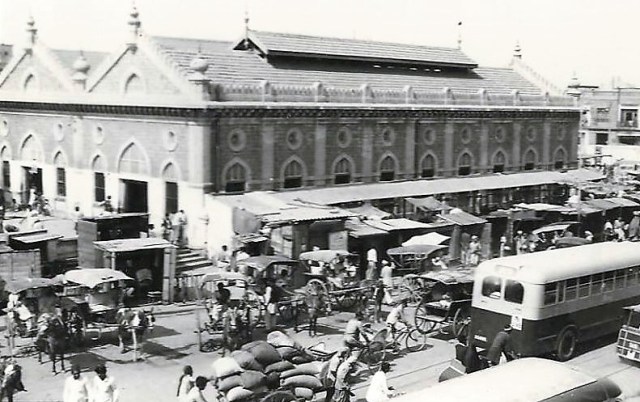
1940 Donkey Cart (1)1945 - Victoria1950 - Elphinstone Street 2 (1)1950 - Lea Market 2 (1)1950 - Tonga (1)1950 - Victoria (1)1961 - Karachi Street & Camel (1)

BullockCartOldB

Posted in Transportation in Karachi | 1 Comment

Karachi Picture House

KarachiPictureHouse
KARACHI PICTURE HOUSE

BY Amin H. Karim

The Karachi Picture House in 1940 was located at the corner of Bunder Road and Shivandas Chandumal Road. This area is just north of where the Old Lighhouse Cinema was constructed and across the street from the Durgah Wali Allah in Gari Khata. It is no longer there and replaced by a building with Muslim Commercial Bank.
The posters tell the story of the show biz scene pre-partition. Apparently the movie running at the time was VIDYAPATI; Vidyapati was a 1937 Bengali biopic film directed by Debaki Bose for New Theatres. It starred Pahari Sanyal as Vidyapati. His costars in the film were Kanan Devi, Prithviraj Kapoor, Chhaya Devi, Leela Desai, K. C. Dey and Kidar Sharma.[2] The music was by R. C. Boral and lyrics by Kidar Sharma. Debaki Bose and Qazi Nazrul Islam wrote the story, screenplay and dialogues. The story is about the Maithili poet and Vaishnava saint Vidyapati.The songs of the film became popular and the lyrics though encapsulating Vidyapati’s poetry were considered bold for its time. This however ensured the film garnered crowds at the theaters making it a big success of 1937′
 
Releasing on February 9, 1940 at another cinema house PLAZA which was about 3 miles north from this area was the movie NINOTCHKA  Ninotchka was a 1939 American film made for Metro-Goldwyn-Mayer by producer and director Ernst Lubitsch and starring Greta Garbo and Melvyn Douglas. It is written by Billy Wilder, Charles Brackett, and Walter Reisch, based on a screen story by Melchior Lengyel. Ninotchka is Greta Garbo‘s first full comedy, and her penultimate film. It is one of the first American movies which, under the cover of a satirical, light romance, depicted the Soviet Union under Joseph Stalin as being rigid and gray, in this instance comparing it with the free and sunny Parisian society of pre-war years.
 
And then there is a poster on the floor for the film WAY DOWN SOUTH: Way Down South was a 1939 American musical film directed by Leslie Goodwins and Bernard Vorhaus, and produced by Sol Lesser. It was written by Clarence Muse, who also acted in the film, and Langston Hughes. Victor Young was nominated for the Academy Award for Best Music
 
Above the poster there is a larger poster for a GUJARATI GARBA on Sunday the 19th
 
Finally there is poster ad for the pre partition Punjabi film Gul-E-Bakawali, also spelled as Gul-E-Bakavali, Gul-e-Bakawali or Gule Bakawali, The film was produced by D.M. Pancholi, starring Salim Raza, Noor Jehan, Suraiya, Hem Lata and Jabeen. K.L. Saigal sang for the film.
 
Look at the diversity of Karachi pre-partition entertainment: Bengali, Gujarati, Punjabi, English. Karachi Picture House, Plaza and most of the cinema houses are all gone, destroyed first by video, then by satellite TV, then by DVD, and finally internet not to mention developers. The houses are replaced by shopping centers.
 
Amin H. Karim May 22 2019
Source Wikipedia and Facebook posts.


Posted in Entertainment in Old Karachi | Leave a comment