Sultana Razaaq-The Charming Actress

By Dr. Sohail Ansari 

Here is another actress from the silent movies era who chose Karachi as her abode following partition.

Sultana Razaaq: a beautiful charming actress who migrated to Karachi after Partition.

Ibrahim Muhammed Yakut Khan was the Nawab of Sachin. His wife, Fatima Begum was probably the first woman director of the sub-continent. Their three daughters, Nawabzadi Zubaida, Nawabzadi Sultana and Nawabzadi Shahzadi, were all actresses. Sultana was an actress from the days of silent films who also worked in talkies and her younger sister Zubeida was the heroine of the first talkie film in India. They were among the few girls who entered the film industry at a time when it was not considered to be appropriate for girls from respectable families.

Sultana who was born in Surat, Gujrat, married a wealthy man called Seth Razaaq and left the film industry. After Partition, they moved to Pakistan and settled in Karachi, with their beautiful daughter, Jamila. The cultural conditions were pretty conducive to the nurturing of talent in Karachi. Jamila started to acquire prowess in classical dance.

Humayun Mirza was very impressed by Jamila and gave her a leading role in his film, Intekhab. At this juncture, Sultana Razaaq also made a movie, Hum Aik Hain, which was released in November 1961. Some of the scenes of the movie were picturised in color, and is considered as one of the first coloured experience of Lollywood. Aslam Parvaiz played the lead opposite Jamila, but the film flopped. Jamila married the well known Pakistani cricketer, Waqar Hasan. He established and runs a business under the name National Foods at Karachi.


Image may contain: 1 person, hat
Posted in Entertainment in Old Karachi | Leave a comment

Nawab of Junagadh

By Dr. Sohail Ansari 

After his exile from Junagadh, Muhammad Mahabat Khan III and his family settled in Karachi, where he died of rabies at the age of 59 years.
He was fond of dogs and is believed to have owned 300 of those. It is said that each dog had a separate kennel and caretaker. British painters were commissioned for painting his favourite dogs and those were hung in his Palace. He was known to arrange elaborate parties to celebrate birthdays and weddings of his favourite dogs.
He once staged a ‘state wedding’ for two of his favourite dogs. Lord Irwin was also invited to grace the occasion of marriage of Roshanara with Bobby. They were ‘married’ with a lavish ceremony, and the Nawab himself headed the wedding procession. He gave the ‘bride’ a Jewelled collar as a wedding gift. There was a nuptial banquet and an extensive fireworks display. Next day someone discovered the ‘bride’ being unfaithful to her husband and matting with another dog. She was executed and the Nawab ordered court mourning!
When leaving for Karachi, planes were chartered to bring his pet dogs as well.
Image may contain: 1 person, standing
Posted in Karachi History | Leave a comment

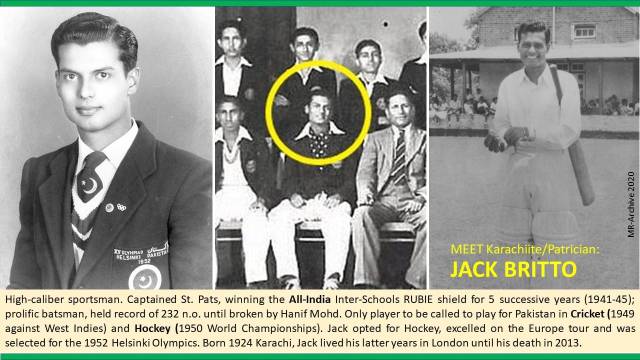
Jack Britto

by Menin Rodrigues


BrittoJackLife

Posted in Contributions by Christians, Karachi Sports | Leave a comment

The Mercy Team of Karachi 1958

By Amin H. Karim 

Karachi 1958; members of the PAF Mercy Team after their return from rescuing an severely injured engineer of a blown up Japanese Tanker Stanvac 200 miles off the coast of Karachi. FLT-LT Sikander Ali in center and looks like Mauripur Airbase.


Image may contain: 1 person, text that says 'GoodOldKarachi.com'
Posted in Karachi Recalled | Leave a comment

Dr. Michael J. Rodrigues

By Menin Rodrigues 

RodriguesMichaelJ

Dr. Rodrigues was a 1964 graduate of Dow Medical College.

Posted in Contributions by Christians, Karachi Sports | Leave a comment

Link of Karachi with Australia

By Dr. Sohail Ansari 

AnsariSohail2018

Karachi long had trading links with Afghans. Before the British conquest, they had established ‘Karavan Serai’ for Afghan traders, outside the confines of the city, where Sindh Madressah stands today. The complex had central grounds and buildings around. It provided the traders with accommodation to live in and posts to run the business, all in the same complex as well as the facilities in the grounds to fend for their camels to provide the animals with food and water and space to rest. In those days, camels used to be a popular mode of transport and also to carry the loads.

Around the time of their conquest of Karachi and Sindh, the British were exploring Australia as well. However, those terrains in Australia were difficult to reach. They needed means of transport to get to the heart of its arid interior consisting vast areas of deserts, Australian outback as it was known in those days.

Burke and Wills from Australia on one of their business trips to Karachi got this entrepreneur idea of importing camels for the very purpose to traverse those difficult terrains on their expeditions. They established links with local agents and Afghan Pashtuns in Karachi to materialise the idea. The first batch of twenty four camels was shipped from Karachi to Melbourne. Eight cameleers from Karachi and Peshawar accompanied the entourage to handle those animals. They arrived at Hobson‟s Bay aboard the Chinsurah on 13th June 1860. They were the ones to make to the heart of Australia, where others failed so often. Others followed this

Over the years (perhaps up to 1930) Sindhi, Baloch, Pashtun and Punjabi cameleers arrived in Australia; it is estimated that between 2000 and 6000 men along with about 20 000 camels were shipped from the port of Karachi.

These cameleers collectively became known as Ghans (from Afghans) in Australia in their mistaken belief that they were all Afghans and indeed a number of them were. They were among the first of the organised Muslim immigrants to Australia and brought with them their culture, traditions and religion. They played a major role in establishing Islam in Australia and built its first mosque which was made of mud brick in Marree in 1861. Though there already were some Muslims before them. This was the beginning of diverse multicultural society in Australia.

So, this links to my earlier post on the first mosque of Australia. I shall continue with some stories of cameleers from Lyari who ventured to Australia.

Image may contain: one or more people and outdoor

Talking of cameleers, here is a story of one of those from Lyari

Dost Mohammed, was an entrepreneur from Lyari, a Baloch. He went on a trade expedition to Australia as a cameleer. There he fell in love with a girl, Annie Grigo. Her family disapproved of the relationship and she eloped with him to get married in Lyari. They returned to Australia, leaving their first born baby boy, Mustafa, behind in Lyari. Dost, who had intended to return home, procrastinated plans and stayed in Australia where he gathered wealth and property. He settled in Port Hedland. Following a patch up with his in-laws, he supported them financially. His brothers in law had a reputation of being violent.

Once during the course of an altercation with his wife, her elder brother interfered which led to a physical assault. As Dost got hold of him, his another brother in law, knocked him with a heavy piece of wood hitting his head that caused a fatal injury and Dost succumbed to the blow. The two brothers were charged with wilful murder but the courts found the accused not guilty and released them.

Dost’s brother decided to go to Australia to establish the facts and look into his heritage, as he suspected Annie to be an accomplice to his brother’s murder. He managed to lure her into an agreement and convinced her to visit Karachi to settle the property issues. She left for Karachi with her five other children.

Annie stayed with her in laws in Lyari but a well wisher warned her of their evil plans to get rid of her. One of Dost’s Makrani friends offered her an accommodation in Malir and she moved into that house. Fearful, she met the District Magistrate with her concerns and sought security. The house in Malir happened to be near the police station and that all seemed re-assuring. Her in-laws desired Lily, her 12 year old daughter, to be married to Dost’s nephew and she refused the proposal.

Ultimately, Annie decided to return to Australia and the plans were all set for Monday the 8th August, 1910. As the family (accept for Mustafa) were sleeping in the large bedroom and she was in bed with her youngest two children, a number of assailants entered through the bathroom window around midnight. They stabbed her multiple times in the back and in the heart. She was murdered on 6th August.

She was given a Christian burial in Karachi and the five children were taken into custody as witnesses. They were handed over to the matron of Civil Hospital to be looked after. Her daughter, Ada, who saw the assailants in pitch dark could not recognise them and the accused four could not be found guilty. The five children were repatriated back to Australia whereas the sixth, eldest son – Mustafa, who was already in Lyari stayed behind with his father’s family.

In those days this was a very famous case as it caused a lot of wrangling between the two governments as well.

These are the photographs of Annie (Mrs Dost Mohd) and their children (excluding Mustafa). The quality is poor since these are taken from an old newspaper.


Image may contain: 1 person
Image may contain: 1 person, standing and outdoor
Posted in Karachi History | Leave a comment

International Telegraphy and Karachi

HISTORY OF INTERNATIONAL TELEGRAPHY and KARACHI.
By Dr. Adnan Zuberi
ZuberiAdnanPP
NOT only as Gateway to South Asia and Australasia in Aerial Communication, Karachi is the first town

of South Asia connected with International Telegraph from Europe.

From Alexander the Great to Vasco de Gamma and later from Dutch East India Co to British EIC, westerners were keeping eyes on Indus Valley Civilisation. When EIC successfully established an Anglo-Indian Empire they need a Faster Communication link throughout Sub Continent and Europe as well. Lord Dalhousie (1847) was a visionary Governer General and he planned to rapidly develop Public Works — Railways, Canals, Roads, Postal Service, Steamship and Telegraph.
William O’ Shaughnessy (1809-1889) an Irish British Medical Doctor and Pioneer in Intravenous Electrolyte Replacement Therapy in Cholera patients, Introduced Cannabis Indica Therapy in Westren Medicine, Forensic Toxicologist and Researcher in Electric Telegraphy. He came to India in 1933 as Assistant Surgeon at age of 24. Here he developed more better Telegraphy system and in 1839 he established and demonstrate 14 miles long Telegraphy line. Lord Dalhousie in 1847 contacted him and Authorised to build Trans India lines by 1854.
WAR OF INDEPENDENCE 1857. The first system of Indian Telegraph was developed before War of Independence. This Faster mean of Communication played a Vital Role in Crushing the Independent Movement. It helps in rapid movements of Soldiers in affected areas, in military logistics and transfer of messages to and from high command and Capital too . One captured freedom fighter being led to the gallows pointed to Telegraph Line and bravely cried,” There is an accursed String that Strangles us”.
INTERNATIONAL SUBMARINE CABLE FROM EUROPE TO KARACHI–
In 1854, Colonial Govt proposed a Submarine Telegraph Cable from England to Karachi. For that they contacted Ottoman Govt for laying a cable from Alexandria ( Egypt) to Karachi. In 1858 funds were arranged and The Red Sea and India Telegraph Company was formed. In 1860 the cable was laid between Suez-Aden-Karachi. The length of a cable was 3000Nauticle miles. Later the landline cable extended to EAST–  Dehli and Calcutta from KARACHI. And towards WEST — Gawader and Persia. This project was completed by W T Henley’s Telegraph Co.
In 1861British govt instructed Col Patrick Stewart of Royal Engineers completed an other Submarine line from Karachi to Iraq.
By 1864 the fastest direct communication then known to man linked between England and Karachi had been established.
PHOTO: Telegraph House, McLeod Road designed and build by Capt P Phelps. Photo was taken by unknown photographer.
Posted in Karachi History | Leave a comment

Rustom and Karachi

By Dr. Sohail Ansari 

Akshay Kumar starred the Bollywood movie ‘Rustom’. Many of you might have seen the movie. The film was actually based on the real life story of Kawas Manekshaw Nanavati, an Indian Navy officer, who was sentenced to life imprisonment for killing his wife’s paramour in 1959. This case shook India.

So, how is it relevant to this page? Here it is how.

The victim’s sister was Mamie Ahuja. She had been impressed by the young Sindhi lawyer, Ram Jethmalani, and gave him a ‘watching brief’: to safeguard the reputation of her slain brother, Prem.

They were both originally from Karachi before immigrating to India.
Ram Jethmalani rose the ladder and served as India’s Union minister of law and justice, as chairman of the Indian Bar Council, and as the president of the Supreme Court Bar Association.
The following news about Mamie Ahuja is from 1937.
FILM ACTRESS AT THE POLLS
Miss Mamie Ahuja, an Indian film actress who received her training for acting in England is to be a candidate for election to the Sind Assembly, according to native newspapers in Karachi.
Other candidates for the same seat include Sind’s first woman lawyer and a Karachi woman doctor; the stage, the law, and medicine will be engaged in the contest. Another proof that things move even in ‘the unchanging East.’
Miss Ahuja is the daughter of a Karachi merchant of ancient family. One of her ancestors was Governor of Shikarpur before the British conquest of Sind. She has appeared In several pictures produced by the Eastern Arts Company.
Image may contain: 3 people
Image may contain: 4 people, text
Image may contain: 2 people, hat, text and closeup
Posted in Contributions by Hindus | Leave a comment

The Waxing and Waning Crescent

By Amin H. Karim 
image.png
WAXING AND WANING CRESCENT.  The flag of the new Dominion of Pakistan in August 1947 was designed and approved in Karachi which was the capital of the country at the time. (Actually in Seafield House, Abdullah Haroon Road)
There is an interesting observation and a piece of history related to the direction the crescent and star face on the flag.  On the flag the crescent has always faced NORTH-EAST.  For most it would not make any difference and the significance of which direction it faced would not be material.  Not until someone in Pakistan first felt the urge in 1998 to bring this to the notice of the Government of Pakistan and filed a writ in High Court.  The plaintiff pleaded that the moon shown on the National Flag was WANING when in fact it should be WAXING.   They stated that the position of the moon determines the destiny of the Nation. To explain what that means here is in simple terms.  Waxing or maxing is growing with light untill the full moon is reached.  Waning is the opposite or decreasing after a full moon when the moon is illuminated on the left.  The Government response at the time was nothing short of brilliant.  The flag is visible on both sides.  The direction of the flag depends on which direction the wind is blowing. When the wind blows from right to left the crescent would appear to be waxing and if it blew from left to right it would appear to be waning,. In a fluttering flag this would change.., Not however on a fixed photo.  GOP also rejected the notion that the destiny of the nation is determined by the position of the moon. (notwithstanding the fact that the Nation had already been cut into two in 1971! )   Hence the flag stays where it is.   Note that Crescent and Star is the motif of the flag of many countries and in most the moon is waning. There are exceptions however; eg flag of Hyderabad when it was a country before 1948 and Herzogovina.  The Muslim League flag before independence (Sabz Hilali parcham) was more diplomatic and kept the crescent facing directly up; Pakistan Post Office (the best department of Government of Pakistan) was wise and printed its first regular series of postage stamps in August 1948 with the crescent facing NORTHWEST i.e. the moon waxing..  it was soon instructed to change this to North East.    Moral of the story:  it matters little compared to what Pakistan has been through and is going through.  But for a superstitious person, maybe it was a or “ill omen” and maybe if it faced the other direction and was WAXING instead of waning, it may have one day become a full moon with a prosperous and glowing Pakistan.   (Amin H. Karim MD)
Posted in Karachi History | Leave a comment

KMC Building 1931

1940s: Karachi Municipal Corporation (KMC) built in 1931. A tram travelling on Bunder Road. Across from KMC is the Shree Swaminarayan Mandir. Many Hindus lived in the Gari Khata, Pakisan Chowk, Haqqani Chowk, before partition. The street names in the area reflect that, South of the KMC Building is the Karachi City and Sessions Courts followed by Campbell Street with Adam Masjid. Some businesses like Friends Optical. Bombay Light House still thrive across the road from KMC. (AHK)

Image may contain: one or more people and outdoor
Posted in Historic Buildings of Old Karachi, Karachi Neighborhoods | Leave a comment