The First Citizen of Pakistan

THE FIRST PAKISTANI CITIZEN: ALLAMA MUHAMMAD ASAD: (1900- Feb 20, 1992).

A linguist, a journalist, a traveler, a scholar, and a writer.

He was issued the first Pakistani Passport, immediately after the independence in August 1947 in Karachi.

*Origin and early life:

Muhammad Asad was born into an Austrian Jewish family as “LEOPOLD WEISS” on 12th July 1900 into a small town called “Lemberg” of Astro-Hungarian empire (currently known as “Liviv” in Ukraine). His father Akiva Weiss was a lawyer unlike his grandparents who used to be Jewish Rabbis for generations. While still at school he got fluency in Hebrew and Aramaic beside his native German and Polish Languages. When he reached his mid-twenties, he also mastered in English, French, Persian and Arabic languages.

In 1920, after his graduation was completed, Leopold went to Berlin to become a journalist. He joined one of the most prestigious media houses in Europe “Frankfurter Zietung” and to prove his skills, he went to knock the door of Maxim Gorky, the famous Russian author, without intimation and successfully interviewed his wife.

*In Middle East:

In 1922, he was assigned by the newspaper to go to Palestine. Where he was posted in Jerusalem. Palestine was then under British mandatory rule. There, he had a chance to observe closely the teachings of all the major religions and consequently he was greatly inspired by the Islam.

In 1926, his love for the Islam took him to Saudi Arabia . He traveled all the way on the camelback, from Jerusalem to Macca through the desert to embrace Islam and acquired the name Muhammad Asad. “Asad” is the rendition of his basic name Leo or Lion.

He lived there for next six years and was very well received by the king Ibn Saud. Who appointed him one of his religious advisors and gave him some other responsibilities too.

By the year 1932, the political scenario began to change a little and so was the environment in the court of king. This made many of king’s advisors to flee out of the country. Sensing the change, Muhammad Asad also left the country and came to settle in british India.

*Asad In British India:

Muhammad Asad came directly to Lahore. Being a renowned Islamic scholar and author of many books already, he was warmly welcomed by the political and literary circles of Lahore, particularly Allama Dr. Muhammad Iqbal. Both of them quickly became good friends. Allama Iqbal actually encouraged him to write his book “Islam at the crossroads”. Which he wrote in no time and was published in 1934.

*Asad imprisoned:

At the start of world war-II in 1939, he was imprisoned by the british authorities in Lahore for he was of Austrian origin and thus the friend of their enemy. While his father Akiva was detained by the Germans into a concentration camp back in Austria because he was a Jew.

Asad was freed in 1942 after three years in prison.

After being released, he came to KARACHI and put all his efforts behind the ideology of Pakistan and worked tirelessly through his writings as a free lance journalist.

Finally the dream came true and Pakistan came into existence on 14th August 1947.

Acknowledging his services and unconditional support for Pakistan, none other than Quaid e Azam himself honored him by presenting him the first passport of Pakistan and declaring him officially the first citizen of Pakistan.

*Asad serving Pakistan:

As Asad was a great supporter of the movement of Pakistan. Therefore in 1947, not only he was awarded with the citizenship of

Pakistan but also he was appointed as Director of the “Department of Islamic reconstruction”.The core responsibility of this department was drafting the first constitution of Pakistan. Which he did successfully but after the death of Quaid e Azam, there was change in the goverment policies. So the first constitution of Pakistan was delayed until 1956. Finally, it was promulgated after much changes and additions into it.

Meanwhile, in 1949 Asad joined the ministry of foreign affairs as the head of Middle East division. In 1952 he was appointed as Pakistan’s envoy to United Nations in New York.

At UNO, he met a Polish American woman named “Pola”. which was to be his third wife. He came back to Pakistan along with Pola and submitted a formal application to the foreign ministry for the approval of his marriage. To much of his surprise! He was denied due to security reasons. This made him resign altogether from his responsibilities for Pakistan and he chose to stay back in New York never to come back again except in 1983, when he was invited for a short trip by then president Ziaul haq. Pola was converted and was named as Hamida Asad and they eventually got married.

*Asad’s literary work:

During his stay in New York he wrote his best seller autobiography “Road to Mecca” which is also translated in Urdu as “Shahrah e Macca” but the greatest work of Muhammad Asad is the translation of Holy Quran in English along with commentary to explain the contents of holy verses.

This book “The message of the holy Quran” took him seventeen long years to complete it and it is regarded as the most comprehensive and authentic translation of the Holy Quran in English so far.

Death:

In later years of his life, Asad went to settle in Spain. Where he died on 20 Feb 1992. He is buried near “Alhamra” in Granada. Which is one of the provinces of Former Muslim Andalusia in Spain. (Adapted and corrected article of unknown source)

May be an image of ‎1 person and ‎text that says '‎PAKISTAN پاکستان 1900 Rs.15 1992 MEN OF LETTERS ALLAMA MUHAMMAD ASAD‎'‎‎
May be an image of 1 person and standing

View insights

2.5K post reach

149You, Zafarullah Syed, Nargis Farooqui and 146 others

44 Comments

Posted in Uncategorized | Leave a comment

Norman D’Souza

By Menin Rodriguez

FILM based on the life of Patrician NORMAN D’SOUZA, who rocked the music scene in Karachi from 1960s and still performs to live audiences.

1978, a Mansfield Films & Sanat Initiative presentation directed by Hamza Bangash is back via Locarno Shorts Weeks! This Pardi di domani nominee from 2020 produced by Rashid Maqsood Hamidi & Abid Aziz Merchant world premiered at Locarno Film Festival in 2020 will be streaming FREE worldwide from Feb 15-21, 2022. Now is your chance to experience the best of 1970’s Karachi lovingly re-imagined.

1978 will be available for free viewing and voting online from 15th to 21st Feb.Don’t forget to VOTE for 1978 as it’s in the running for the Audience Award.

#sanatinitiative#sanatxmmc#1978thefilm#locarnofilmfestival#shortfilm#karachi#audienceaward

May be an image of 1 person and text that says 'Locarno 2020 Pardi domani Official Selection 1978 ۹۹۸۸ WRITTEN & DIRELTED BY HAMZA BANGASH EXECUTIVE PRODUCERS RASHID MAASOND HAMIDI ABID AZIZ MERCHANT STARRIND MUHAMMAD ZEESHAN SHERWYN ANTHONY RUBYA CHAUDHRY NAVEED KAMAL DEDICATED τα NORMAN D SOUZA'
Posted in Contributions by Christians | Leave a comment

Capture of Manora Island circa 1839

By Dr. Sohail Ansari

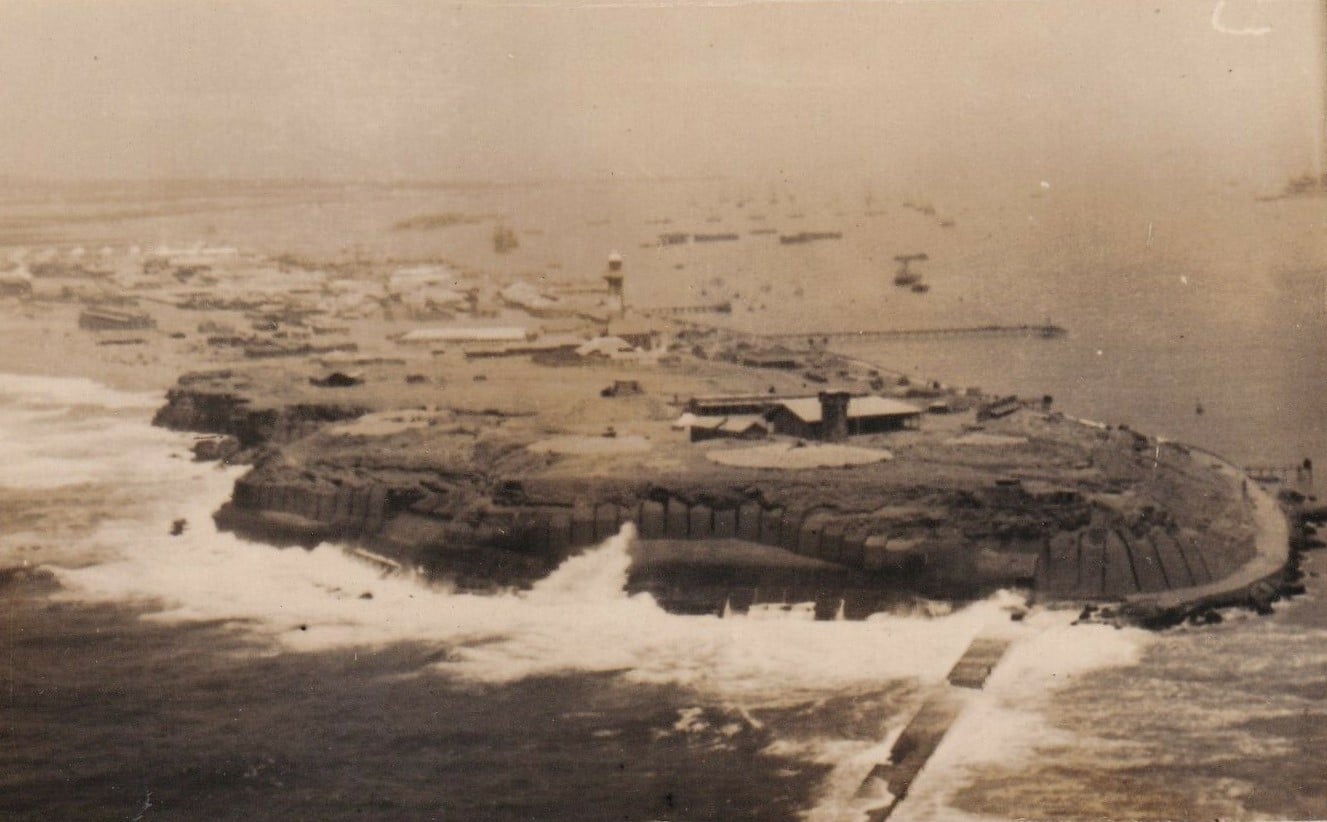
3rd February 1839 was a game changer for Karachi. The Fort of Manora came under fire, when East India Company stormed and captured Manora, leading to fall of Karachi under the Raj. Four years later, the rest of Sindh was also captured. Karachi was required as part of British strategy in Anglo Afghan War, due to it’s location. The port was what attracted the invasion, besides accessibility to Punjab and beyond. The history of Modern Day Karachi began with that capture. What was then a sleepy small fishing village quickly transformed into a major seaport. It soon became a big metropolis. The following century saw the growth of Karachi never witnessed before. This drawing was made on 2nd February 1839 as HMS Wellesley prepared to invade Manora under the command of Rear-Admiral Maitland.

Sir Alexander Burns had long recommended that ‘Kurrachee’ should be the first point to be occupied. In January 1839, Colonel Pottinger also advised that a force must go to Kurrachee, in order to take possession of that place.

H.M.S. Wellesley set sail with Rear Admiral Frederick Maitland, Commander in Chief on board to conduct the operations. The land forces were under the command of Brigadier Valliant.

On one hand negotiations were ongoing between the British and Talpur rulers who had already been squeezed hard. On the other, as a surprise, the Wellesley arrived unexpectedly all of sudden.

She attacked on the pretext that a gun was fired from the Manora Fort on their ship. It is controversial whether the gun was actually fired or not. If it was, there was debate on whether it was an actual act of belligerency, or a mistake, since the Manora Fort was grossly ill equipped for combat at the time.

The Fort of Manora was basically a mud made structure which was not really fit for defence. The Fort commander or ‘Killadar’ of Manora was a brave Baluchi soldier, Wasul Ben Butcha. There hardly were enough men in the Fort to think of them taking advance of firing the World’s super power navy. There were not even enough guns to hand. So, it is very unlikely that the Fort would have fired the ship. On that context, though, the British flagship 74-gun HMS Wellesley bombarded the Fort. It was completely smashed to smithereens by the bombardment. It engulfed the sky with smoke.

Despite all his pride the Baluchi Killadar was made to surrender and he hoisted the white flag. The army of British ground force immediately stormed Manora and Karachi. Consequently, the British took over Karachi on Sunday the 3rd February 1839 . It happened quickly within a matter of hours. Following surrender agreement, Karachi was formally occupied by the British on Thursday the 7th February 1839.

Seth Naomal Hotchand had corroborated with the foreign forces to help them plan the invasion and take siege of Karachi.

Manora turned out to be the gateway to the capture of Karachi (and subsequently of Sindh). The fortunes of the city changed and it witnessed an unprecedented growth in the following century.

Posted in Karachi History | 3 Comments

Naheed Iskander Mirza

By Dr. Sohail Ansari

May be an image of 3 people and people standing

Nahid Iskander Mirza 6 February 1919 – 23 January 2019In 1951, Mohammad-Ebrahim Mirza Amirteymour Kalali was posted as Iran’s Military Attaché to Karachi. His daughter, Nahid Afghamy came with him. She was married to Colonel Mehdi Afghamy and had a daughter. It was then that she met Iskander Mirza, Secretary of Defence of Pakistan, at a reception in the Russian Embassy. He was married too, and had six children. Still he fell in love with her. The love blossomed, she divorced and married Iskander Mirza in September 1953.

POSTED BY MR. NASSAR SHEIKH:

Naheed: The Mysterious First Lady of Pakistan

By Waseem Altaf

She was the wife of Iranian military attaché to Pakistan namely Lieutenant Colonel Afghamy in 1951. It is conjectured that since the Colonel had close dealings with the Ministry of Defense, Naheed met Pakistan’s Secretary Defense Sikander Mirza in some social gathering at Karachi. Perhaps they got involved much earlier, however, It was much later that the family of Sikander Mirza came to know of the close relationship.The Secretary Defense’ elder son Hamayun Mirza was studying in London and every summer Sikander Mirza and his wife Rifat Mirza would visit their son in UK. In early 1952 Hamayun Mirza, received a letter and some money telling him that the wife of Iranian defense attaché would be visiting London and he was to take care of her during her visit. Later that year, Sikander Mirza asked his son Hamayun to look for a suitable school for the younger daughter of Mrs. Afghamy. In the spring of 1953, Mrs. Afghamy herself took her daughter to a school in England for enrollment.On June 4, 1953, the younger son of Sikander Mirza got killed in a plane crash. Sikander Mirza came to Selsdon Park Hotel in Croydon, Surrey for a private grieving. It was here that Hamayun witnessed Naheed coming to the hotel and comforting Sikander Mirza in a very intimate way. The son got infuriated by Naheed’s behavior but some guests cooled him down. A few days later Sikander Mirza sent his son Hamayun to Karachi to join his mother and four sisters while Sikander and Naheed stayed behind. A month later Sikander returned to his family in Karachi.In April, 1954 Sikander Mirza was appointed governor of East Pakistan as the ruling Muslim League lost elections in the province and governor rule was imposed. Sikander Mirza left for Dhaka but chose not to take his family along.It is not known when Naheed got divorce from Colonel Afghamy but she admitted that she and Sikander Mirza got married by proxy on July 7, 1953.However, the actual marriage ceremony took place on September 5, 1953. But there is no public record of her account.In November 1954,Hamayun was getting married with the daughter of US ambassador in Pakistan Horace. A. Hildreth yet none of his family was present at the occasion. His mother Rifat was in China with a women delegation while Sikander Mirza was in Karachi with his four daughters. It was then that Naheed informed him that she could no longer be his secret wife and the relationship must be disclosed to the public. Sikander disappeared for one week and on his return informed his four daughters that he had married the ex-wife of Colonel Afghamy. The son Hamayun came to know of his father’s secret marriage on his wedding day while the first wife Rifat became aware of her husband’s second marriage after she returned from China. Sikander Mirza left his family for good and from then onward Naheed was to play a pivotal role in his life.On October 6, 1955 Sikander Mirza took the oath of Governor- General and a week later all four provinces of West Pakistan were merged into a single West Pakistan Province to create parity with East Pakistan. On March 6 Sikander Mirza was elected as President and the constitution was promulgated on March 23, 1956. Three days later, on March 26, 1956 with Nahid on his side Sikander Mirza took the oath as President of the Islamic Republic of Pakistan. Thus, in a passage of two years, mostly through palace intrigues and backroom dealings, an ex-soldier and a career bureaucrat rose from the level of a department head to the position of the Head of the State. And the Iranian born Nahid Afghamy, the wife of a Military Attaché lifted by a government Secretary of the host country, became the First Lady of Pakistan. For the next two and a half years Nahid Mirza as wife of the President was to play a significant role in the national and international affairs of Pakistan. (Pervez Munir Alvi,2013)Mirjaveh, which is the main crossing point between Iran and Pakistan, was ceded to Iran under the presidency of Iskander Mirza. Nahid Mirza played an instrumental role in the deal, Ahmed Yar Khan writes in Inside Balochistan.Exiled by General Ayub Khan in 1959, who took over power in a military coup, Mirza lived remainder of his life in exile in London, England where he financially struggled running a small Pakistan cuisine hotel until his death. He died of a heart attack on 13 November 1969, his 70th birthday. President Yahya Khan denied him a burial in Pakistan. The Shah Mohammad Reza Pahlavi sent his personal plane to London to bring President Mirza’s body to Tehran, where he was given a state funeral. Hundreds of Iranians, including Prime Minister Abbas Hoveyda, and Pakistani expatriates in Iran bade farewell and offered their prayers.The funeral ceremony was marred by the absence of Sikander Mirza’s relatives living in Pakistan. The military government barred them from leaving Pakistan in time despite the best efforts by Ardeshir Zahedi, Iran’s foreign minister, and President Sikander Mirza’s friends in Pakistan and Iran. There are unfounded rumors that after the Islamic Revolution in Iran (1979), his grave was desecrated.Naheed spent rest of her life in London in anonymity. Shepassed away in London on 25th January 2019.

30Yasmeen Kazi, Ghulam Nabi Kazi and 28 others11 CommentsLikeComment

Posted in Karachi History | 1 Comment

Plane Crash 1949

By Dr. Sohail Ansari

As published in the DAWN today:ON Dec 12, 1949, a DC-3C Dakota of Pak Air Services flying from Lahore to Karachi crashed at Karo Jabal near Jungshahi. All 26 on board perished. Among them was Maj-Gen Muhammad Iftikhar Khan, who was a strong contender for the appointment of the first Pakistani Commander-in-Chief, pegged to succeed Gen Douglas Gracey. Another on board the plane was Brig Sher Khan, Director of Military Operations.Their funeral prayers were held on the grounds of the Frere Hall in Karachi, and the burial was at the Armed Forces Cemetery. There were speculations at the time that the path was cleared for one of the other officers.Regardless of the merit of the speculations, what did happen was that Ayub Khan took over. Was the air crash an act of sabotage? Did that change the course of history? It certainly led to a ban on the airline, following a series of air accidents; four of them. The probable cause was said to be the pilot’s error in terms of navigation and not following the standard procedures

.Dr Sohail AnsariEssex, United Kingdom

May be an image of 10 people, people standing and outdoors

12Saad Bashir, Shah Muhammad Vaquas and 10 others3 CommentsLikeComment

Posted in Karachi History | 3 Comments

Ladies Gymkhana Karachi

By Safdar Nensey

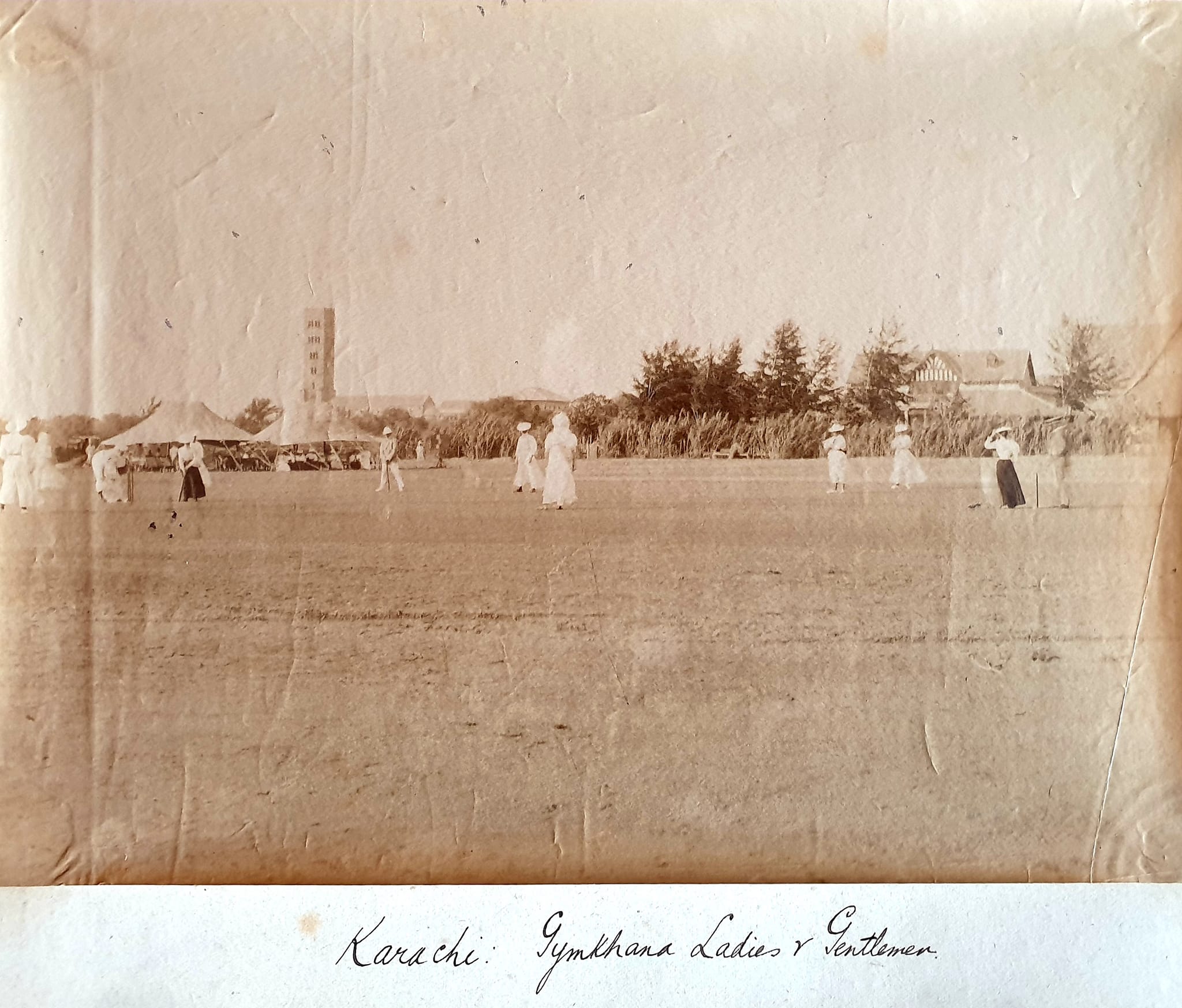
I recently acquired the attached undated, large sized & paper thin, photograph pertaining to Karachi. It is about always easier to judge the age / date of a vintage postcard if it is postally used. If not, even then in this day & age of internet, one can “find” the age through Google et al search. However, in the case of this photograph of Ladies Gymkhana (now Karachi Gymkhan), it was a wee bit challenging. I am dating this photograph to circa “turn of the 20th century” (early 1900s, perhaps even pre-1900 to 1905) based on the following premise: Firstly, such thin paper photographs (stuck on cardboard pages of an album) are indicative of an older vintage (pre-1900). After ~1910 or thereabouts, paper used for photography printing was much thicker. Secondly, on the left-ish corner of the photograph, one can see the tall Holy Trinity Church (build in ~ 1855) with its upper floors, built to serve as a lighthouse too for ships arriving at Karachi Harbor, still intact. They were partly removed, about 40 ft in total, in 1905, “owing to the foundations’ showing signs of weakness” (Reference: Karachi Handbook & Directory 1928-29). Based on this, it is inferred that the photograph is atleast taken in 1905, if not earlier.This note is a bit longish. However, I alway see if I can provide some context to the picture and hence add value, as I see it, instead of simply sharing them, which again is not bad at all. Hope this help a bit. After this post, I will share 2 additional vintage postcards of the Holy Trinity Church – one with the tall tower and the other with the shorter one – but both are classified as vintage.

66You, Tariq Aslam, Tahir Shamsi and 63 others19 CommentsLikeComment

Posted in Karachi History | Leave a comment

Karachi’s First Liqour Tavern

Karachi’s first liquor tavern MOKHI AND MATARA – A folk tale

By Dr. Sohail Ansari

The story of a tavern in Karachi dates back to around 400 years.

Perhaps this is the oldest recorded tavern of the city. Natar, a maid of Moomal, came to a village called Konkar (modern day Gadap) and settled here. She established a brewery and tavern which became popular locally as well as in far flung areas attracting customers. Her beautiful daughter, Mokhi, served as a barmaid. The delicacy of wine and the charms of Mokhi rapidly gained fame which brought revellers from all over. Among the admirers were eight Matara (which in Sindhi mean strong) warriors: two each from the Samma, Soomra, Channa and Chauhan clans. Having enjoyed multiple drinks form pots of old wine and seduced by the attractive barmaid, these brave visitors left tranquil but decided to return. On one of their returning trips, Mokhi had run out of old wine. Perturbed, she discovered an old wine jar which was years old long abandoned in the depot. The wine appeared very colourful and had a fragrance. The Mataras were delighted with the wine and commented “Never did we taste such a wine”. Heavily intoxicated, they left the tavern dancing in tranquility. Once they had gone, Mokhi discovered a long dead snake in the pot of wine that she had served them. She thought the Mataras would have perished but to her surprise they returned some time later. She happily served them the best old wine from her stock. Consuming glass after glass, they demanded the wine that they were served on the last visit. Reluctantly, Mokhi had to tell them the truth that the wine they drank on last visit was poisoned with cobra venom. The very thought of venom and its effect shocked them and they all fell dead on the spot and were buried there. The graves are still there in the old graveyard on the hillock, to be found at the foothill of Narathar in Gadap tehsil of Karachi! Shah Abdul Latif Bhittai, narrated this folk tale in Sur Yaman Kalyan.

No description available.
No description available.No description available.No description available.

(Photo courtesy: Friday Times, Umer Soomro, and Khurram Saeed Khan)

Posted in Karachi History | Leave a comment

Dinshaw House

By Dr. Sohail Ansari

May be an image of brick wall and outdoors

A man sprung from poverty and in 1890’s was said to have owned half of Karachi. He built a house, the Dinshaw House in 1890, on Ingle Road. It once became the residence of Pakistan’s President, Iskandar Mirza. Decades later, Pakistan’s first press club, Karachi Press Club, was established in Karachi. The Club acquired that bungalow as its home, commencing its journey in 1958. The first election was held then, and yearly thereafter. It has since been democratic. It not only arose in the face of National Press Trust but also survived the tough times of censorship, raising its voice. Some equate it to the Hyde Park.In the 1970s during the military rule, a senior military official who walked into the club to have a cup of tea, was forced to leave.Half a century ago, around this time of the year, the house that is now over 130 years old, was buzzing with democratic activity. Results for its elections for the year were announced on 5th July 1971 and those elected faced the media on 7th July. Dawn group clearly dominated the scene. Anwar Husain of Dawn was elected President of the KPC, S.M. Fazal of Daily News, Vice-President, Mirza Ismail of Dawn, Secretary and Hasan Shahriar of Dawn was elected Joint Secretary.

Posted in Contributions by Parsis | 1 Comment

Sister Gertrude Lemmens

By Dr. Sohail Ansari

Sister Gertrude Lemmens, founder of Darul Sukun: She was the Angel of Karachi and ‘mama’ to the residents of Darul Sukun.Born on 14 July 1914 in Venray, Netherlands, she departed on 30 October 2000 in Karachi.She was the daughter of a Dutch factory manager and was engaged to be married to a university professor in the Netherlands. She arrived to Karachi in October 1939 at the age of 25 to visit her brother, Fr. Salesius Lemmens. He was the Apostolic Prefect of the Catholic Church in Karachi and died in 1942 at the age of 39 in a drowning accident. Having seen the plight of the poor and following her brother’s death she decided to stay back to continue her brother´s mission for special children and broke off her engagement. She joined the Franciscan Missionaries of Christ the King.

She was a nun, a midwife and a teacher of English at Christ the King School.She first returned to her native country in 1957, some 18 years after she left it.In 1969, when Archbishop Joseph Cordeiro of Karachi bought single-storey property on Kashmir Road for setting up a school, she convinced him to turn over the property to her so that she could start a home for children with special needs. Darul Sukun was, thus, founded on 17th February 1969.In 1970 she again travelled back to Holland and made TV appearances and newspaper appeals for aid for the struggling home. She successfully obtained help from philanthropists and Dutch companies like KLM. The home was supported by the Dutch people with approximately half a million euro raised to finance the project between 2004 and 2008.

The queen of the Netherlands presented an award to Sister Lemmens in 1975. The government of Pakistan awarded its own Sitara-i-Quaid-i-Azam to her in 1989.

May be an image of 3 people and text
Posted in Contributions by Christians | Leave a comment

A Jewish Cricketer From Pakistan

An Introduction of the book:

A Jewish Cricketer from Pakistan – Autobiography of Isaac Solson (Soloman)

By Menin Rodrigues (Excerpts from the book)

TORONTO: 6 July 2021 – Isaac Soloman (as he was known then) was born to Jewish parents in 1949 in Karachi, Pakistan. His grandparents came from Pune in Maharashtra state, India, and had moved to Karachi prior to Partition along with several other Jewish families who were seeking better employment opportunities. 

He writes in his book, “Our community is known as Bene-Israel, which means ‘the Sons of Israel’, and is said to be made up of descendants of the Lost Tribes of Israel, who settled in India. Since my forefathers lived in Maharashtra, we spoke Marathi, which is still our home language.”

Isaac was a promising cricketer who studied and played for St. Patrick’s College and was coached by the great Jacob Harris – who also coached several Test cricketers like Wallis Mathais, Antao D’Souza, Wasim Bari, Khalid Wazir, and others like Rashid Israr, Feroze Dada, Muzamil Hussain, Zohair Karimi etc. Isaac also played in the Karachi cricket leagues and was selected to play for Karachi in the Ayub Trophy.

He says in the second chapter “I discovered cricket and life in Nazimabad – it is only after we moved here that I have any vivid memories. Until seventh grade, I and two of my older sisters studied at Happy Dale School…as a child I participated in many school plays and shows. Our life was quiet and simple, and my dad and mom used to work for a living.”

Isaac made many life-long friends in Karachi, from his days living in Nazimabad and from his cricket playing days at St. Pat’s College and the city’s top cricket clubs. He remembers his friends and several other people who helped him grow into a fine gentleman, a caring family man and a successful individual, now happily retired and living in the USA. 

His college-mate Feroze Dada FCA, CTA writes from London, “We played cricket from 1969,70 and 71 and parted when I left for London in the summer of 1971. I remember Isaac as a decent and well brought up young man that made a lasting impression on me…”  

The book is a fascinating recount of his years in Karachi, his vibrant community, his and other Jewish families, their religious customs and living a happy and peaceful life in the city before leaving the country in 1971. He moved to Israel, pursued his passion for cricket and represented Israel in the inaugural Cricket World Cup in 1979 and again in 1983. 

His is an endearing story to read, a must for every Karachiite who can recall the peaceful coexistence of communities in the city. 

The BOOK is available on www.amazon.com 

Posted in Contributions by Jewish Community | Leave a comment