Flavor of the Past

Food for thought: Flavor of the past

(Source: Dawn, published on SEP 06, 2009 – written by an anonymous)

I was six when my father took me to Karachi in 1945. My father, a Khilafati mullah; me a child from the zig-zag streets of Hyderabad; it was my first visit to the expanding multi-cultural society of the would-be-metropolis. At that time the town was confined to the Old Karachi, Cantonment, Saddar, Port, a small airport in the area now called Gulshan-i-Iqbal, the two railway stations, parts of Clifton, Soldier Bazaar, Amil Colony and the industrial area of Landhi.

The life of a common Karachiite was quite different from what today’s sprawling city presents. Today’s Karachi offers a mosaic of various cultures.

Let us take the eateries. Though Malabari restaurants are now vanishing and the Iranian cafes are also in decline they were in their prime during the late 1940s and early 50s. Malabari restaurants were the meeting place for the average citizens, middle-class businessmen and low-income groups. Iranian restaurants, with their distinctive furniture and food style, were quite popular with almost all professionals. The Eastern Coffee House and the Zelin Coffee House in Saddar were the popular meeting places for writers, poets and intellectuals.

Cafe George, which was a popular meeting place for journalists, poets, writers and artists, remained so for many decades after Independence. Situated opposite the Eastern Coffee House, it was known for coffee, tea, biryani and patties; it exuded an air of elegance with its uniformed waiters and fine service.

Race lovers, punters and racing journalists would collect at Fredrick’s Cafeteria in Saddar, both before and after the race. The only difference was that in the latter case, all the bills would be borne by the winner.

McLeod Road — now I. I. Chundrigar road — was another area with a collection of popular restaurants. Being the hub of printing and newspaper offices, the restaurants of this area drew mainly journalists, columnists and printers. Green Hotel, which has now been supplanted by a bank, was a residential hotel but its cafeteria was regularly frequented by professionals from the vicinity.

At the eastern end of the road was the famous Iranian Cafe, Khairabad, one of the few relics of the pre-partition days that still survive. As in the days of yore, it remains a meeting place and eatery for newsmen, columnists and writers; the staff members of the nearby power house and now a KESC outlet also make up its regular clientele.

Cafe Liberty, now just a fading memory, was one of the busiest restaurants of Karachi. Located at Tariq Road, the fashion bazaar of the middle class, it offered a large variety of food. For those who preferred a calm ambience, there was the Western Hotel, off Queens Road. Built in the style of old Gothic architecture, it was a haunt of intellectuals and frequented mainly by the older generation.

Karachi’s large Goanese community, which has unfortunately almost disappeared with time, gave the city a taste of their unique cuisine. A number of small restaurants offering Goanese food could be found in Saddar and were frequented by people of all communities. That these friendly, unique eateries have been replaced by run-of-the-mill fast food joints is one of the many tragedies of this city.

Since Karachi also had a substantial Hindu population at that time, there were a number of eateries offering vegetarian cuisine, many of which were located in Boulton Market. The Sindh Hindu Wapari Hotel, located on the first floor of a building in the main market area, was perhaps the most famous. Charpaeeys instead of tables and chairs and the complementary pickles and papars served with each meal, were some of the unique features of this restaurant.

The Ram Swami temple on Bunder Road, opposite Karachi Metropolitan Corporation, was another place to go for a vegetarian meal. A small hotel situated right next to the temple continues the tradition and is a good place for all those who are looking for simple but delicious food.

In the early years of Independence, Karachi grew at colossal speed and so did its food industry, with new eateries coming up all the time. Bundoo Khan was among the first to introduce kebab paratha and his first outlet behind Taj Complex is still one of the most popular eating spots in the city. His ads had a unique character as well.

Suniye janab wala
Kya kahata hai munadi wala
Mulk khuda ka
Paratha kabab khan ka.

Rising from a fishing village to a sprawling metropolis, Karachi is a unique town; so are its eating habits. From posh restaurants to make-shift roadside dhabas to fast food chains, Karachi’s food culture is a colourful mosaic that has evolved over 270 eventful years and continues to do so.

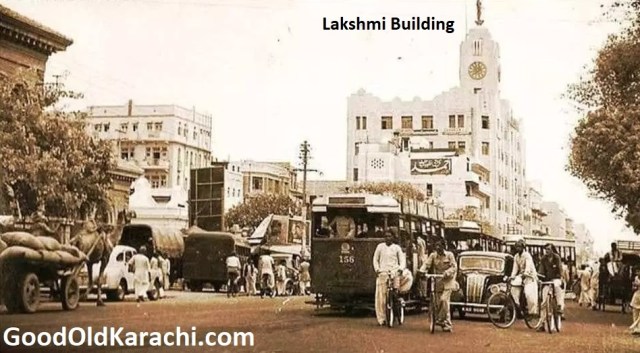
Courtesy of Mr. Bakhtiar Khalid on FaceBook Post July 15 2018. Karachi Past and Present Group. LakshmiBuildingTramAhmedTag
Posted in Karachi Recalled, Uncategorized | 1 Comment

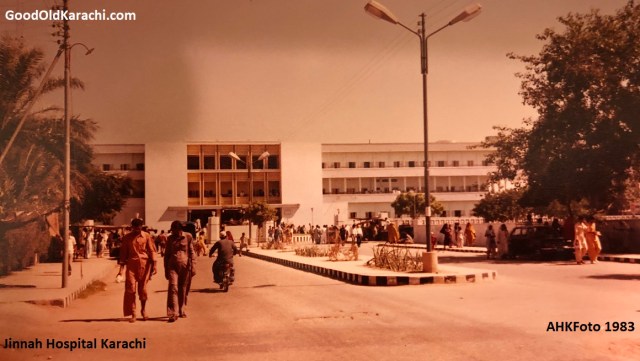
Jinnah Hospital Karachi.

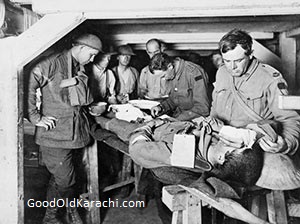
Jinnah Postgraduate Medical Centre (JPMC) started in 1930 in Medical Corps Hospital, meant for medical aid to military personnel exclusively. In 1942 it was re-named as the British General Hospital and remained as such till 1947; a 100 bedded hospital with all basic necessary facilities.
JinnahPostgradMedCenter1930

    After the creation of Pakistan in 1947, the father of the nation, Quaid-e-Azam Muhammad Ali Jinnah was requested to grant approval to lend his name to the hospital, which he graciously accorded, with the condition that it be opened for the public. Thus the Medical Corps Hospital/British General Hospital was named as Jinnah Central Hospital (JCH).
Being the capital city of Pakistan at that time, Karachi became home to thousands of Federal Government employees, who settled here along with their families. The Government of Pakistan decided to establish JCH as a well equipped hospital to cater for their medical needs, as the existing Civil Hospital was inadequate for this purpose.

JinnahPostgradMedCenter1952

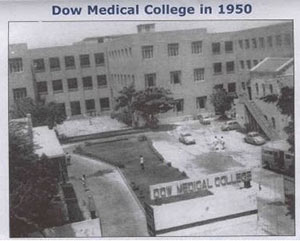
In 1952, Dow Medical College (DMC) was attached with JCH. In August 1954 the National Assembly of Pakistan authorized the Basic Medical Sciences Institute (BMSI), as basic sciences education was deemed crucial to establishing a centre for higher medical education. After its initial establishment at DMC, Karachi, the Government of Pakistan changed the site for the development of BMSI to a building situated at the site of JCH. The Indiana University with its staff embarked on the establishment of BMSI, headed by Dr. Paul A. Nicoll, Prof. of Physiology who deserves major credit for accomplishment of this assignment. He was ably assisted by Dr. Osgood D Priddle, Prof. of Pharmacology and Dr. Rolla N. Harger, Prof. of Biochemistry. The BMSI with six departments and laboratories, including Anatomy, Biochemistry, Microbiology, Pathology, Pharmacology and Physiology, was thus established as the most updated medical institution of its time. The official opening ceremony was held on 11th April, 1959. Speakers on this occasion were the President of Pakistan, General Muhammad Ayub Khan, President of Indiana University, Dr. Harman B. Wells and Director General Health, Col. M. Jaffer.
DowGate1950s
    The opening ceremony was a grand affair. The first class of students was inducted on 1st June, 1959. In 1963, the amalgamation of BMSI and all units of JCH led to the creation of JPMC with the combined administration headed by a Director.
JPMC, thus established, comprised of a cluster of buildings spread over 148 acres. The prime purpose of this institution, in addition to treating patients, became higher medical education, training and research. Thereafter, with the passage of time, more buildings were constructed to cater to the growing needs of various evolving specialties. It can now proudly claim to be the biggest and the best equipped public sector hospital in Pakistan, employing highly qualified staff in numerous specialties, ready to render quality health care services to the ailing. In the process, JPMC also imparts high quality training to medical graduates, nurses and technicians and undertakes meaningful research in clinical and basic medical sciences.
NOTABLE PHYSICIANS OF JPMC.
These are some phyisicians that we remember were well known in the Karachi physician community.
Please add other names.
Late Prof. Shaikh Abdul Hamid was Chairman of Department of Surgery. Founded the Pakistan SOciety of Surgeons,
       and Founder-Editor of Pakistan Journal of Surgery.
Late Prof Syed Mohibur Rab was Chairman of Department of Medicine
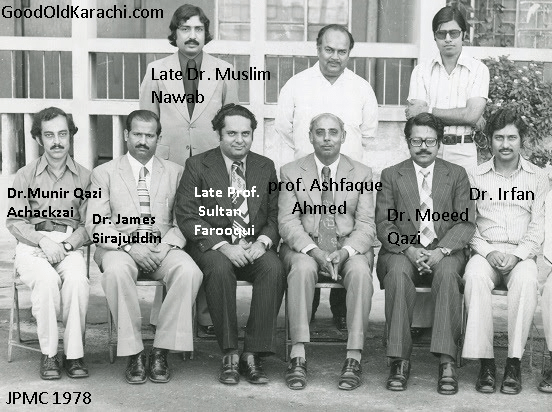
Late Prof. Ashfaque Ahmed, Department of Medicine, Ward 3
Late Prof. Sultan Farooqui.
Late Prof. Mohammed Attar,. Department of Anesthesia.
Late Prof. Omer Vali Jooma, Chairman Department of Neurosurgery
Prof. Rashid Jooma, Department of Neurosurgery.
Prof. Zaki Hassan Psychiatry; Later become dean of Baqai Medical College
Prof. Suleman, Orthopedics
Prof. Saghir. Orthopedics.
Prof. Kazi, Orthopedics.
Prof. Hamida Sharif, Intensivist.
Prof. Kashf Ud Dujha, Principal of Sind Medical College.  Was Professor of Physiology at Dow Medical College in the 1970’s.
Prof. Asadullah Khan, Surgery.
Prof Zaidi of Radiation Oncology
Dr. B.A. Qureshi, Administrator of JPMC
Dr. Shahid Kamal. (Dow 1977) Nuclear Medicine Department.
Prof. Saadiqa Jafry, Obstetrics and Gynecology.
Prof. Saleh Memon, Ophthalmology
Prof. Saeed Kirmani.
Prof. Haroon Ahmed, Psychiatry.
Prof. I.H. Rathore, Chest Surgery.
Late Prof. Hamid Ali Khan, Chairman, Department of Pediatrics.
Late Dr. Abu Bakr Momal, Department of Surgery
Prof. Mahmooda Said, Chairperson, DepartmentOb-Gyn.
Late Prof. Minhas, Department of Medicine, Ward 6.
Prof. Hasan Aziz, Neurology.
Prof. Ibrahim, Director of JPMC in the late 60s and founder of the Diabetic Association. Prof. . Samad Chawdary, Prof of Gynecology in 1950’s.
Prof. T.S. Haroon, Dermatology.
Prof. Zubaida Kassam, Physiology.
Prof. Zakaullah Baig, Chest Medicine.
Prof. I.H. Bhatti, Neurosurgery.
Captain Rasheed, General Surgery.
JinnahPostgradMedCenter1978
 JinnahHospitalKarachi1983
Posted in HealthCare Institutions | 2 Comments

Dow Medical College Karachi

DowDaysCom

Dow Medical College established in 1945 before India Partition was the first medical school in Karachi. It grew into the one and only and a premier institution until
1970s when other medical schools were started.  In 2018 it has completed 73 years of existence having trained thousands of doctors.  It is now a university (Dow University of Health Sciences) and trains not only physicians but also dentists, technicians and
other medical professionals. Physicians trained in Dow have done remarkable things in medicine, establishing new institutions and colleges. The outstanding example is
Prof. Adeeb ul Hassan Rizvi and the Sind Institute of Urology and Transplantation.
(SIUT).  Another example is Prof. Abdul Bari and the Indus Hospital, Karachi.  There are many more examples that will be found in website with details.
To know more about it’s history, its alumni, it’s role in politics of Pakistan in the last
century, its illustrious faculty and much more please visit the website:
http://www.thedowdays.com

Amin H. Karim MD
Class of 1977.


Posted in Educational Institutions of Karachi | Leave a comment

Jewish Community of Old Karachi

By Raju Jamil
JamilRajuSmall
Not many people know that a number of Karachi’s landmark buildings were designed by a Jewish architect Moses Somake (1875-1947). While he was born in Lahore, he lived most of his life in Karachi before migrating to England a few months before the Partition of India.
Reading a paper at Karachi conference here on Saturday, Gul Hasan Kalmatti, traced the history of Karachi’s Jewish community and recalled their contribution in making Karachi a vibrant metropolis.
“It’s funny how [the other speakers] have mentioned Kalhoros and Jatois,” said Kalmatti, referring to tribes who still exist today. “But today I am speaking of the Yahudis [Jews]. The Kalmattis are still here but the Jews are not.”
MosesSomakeKarachiSM2
He revealed that historic buildings like Mules Mansion in Keamari, BVS Parsi High School and the Karachi Goan Association Hall in Saddar, Khaliqdina Hall on Bunder Road, Jaffer Faddoo Dispensary in Kharadar, Edward House on Victoria road and the famous Flagstaff House were all designed by Moses Somake. “They were our stones, our buildings,” he said. They are no longer there. The design and architecture of some famous hotels of yore – North-Western Hotel, Bristol Hotel and Carlton Hotel – was also conceived by this architect of Iraqi origin.
Tracing the history of Karachi’s lost Jewish community, Kalmatti said they belonged to the Bene Israel diaspora who had settled in the early 19th century coastal towns of India, including Karachi. Most of these people had settled in quarters along Lawrence Road, Ramswami Quarters and Ranchore Lane.
You will still find nine streets from Jubilee market with the names from our Hindu, Jewish and Muslim heritage: Solomon David street, Seth Harchand street after the mayor of 18 years, one named after Yousaf Ali Alibhai who organised cricket.
Kalmatti regretted that the synagogue known as the Magen Shalom Synagogue was razed to the ground in July 1988, paving the way for a shopping plaza – Madiha Square. The synagogue was built by Solomon David Omerdekar in 1893. In 1895, a community hall was added to this synagogue in memory of Solomon’s wife, Shegulbai. His sons established a Hebrew school in the synagogue’s premises in 1918 and constructed a Nathan Abraham Hall. Solomon, who was the chief of the city’s Jewish community and a surveyor of the Karachi Municipality, lies buried along with his wife in Karachi.
According to Kalmatti, a leading member of city’s Jewish community, Abraham Reuben, was elected to the Karachi Municipal Corporation thrice – in 1919, 1936 and 1939. He established a school in 1927 that still exists in Liaquatabad’s Haji Mureed Goth and is named after him.
Giving the estimates about the growth of Jewish population in Karachi, Kalmatti said that according to the 1881 census, there were only 153 Jews in Karachi and the number at the time of Partition of India stood at 2,500. But most of them migrated to Israel after it came into being in 1948. However, by 1968 there were only 250 Jews living in Karachi. After their synagogue was destroyed, the remaining few Jews, fearing for their lives, started identifying themselves as Parsis and Christians.
At the end of his presentation Kalmatti sounded quiet poignant, recalling that Karachi was a tolerant, peaceful city when inhabited by people from diverse religious backgrounds. “We are 99% Muslims now but we’re cutting each other’s throats,” he said. Today when there are no Jews, fewer Hindus and only a few Goans and Parsis and the overwhelming majority subscribe to the same religion, they are after each other’s blood.
Posted in Contributions by Jewish Community | 4 Comments

Two Karachi Ladies With a Mission

TWO KARACHI LADIES AND A MAN WITH A MISSION: Earlier this year I was driving down Mission Road. I saw the name of old Civil Hospital Karachi had changed to DR. RUTH K.M. PFAU CIVIL HOSPITAL KARACHI. A short distance down the same road on the opposite site I saw the gates of the LADY DUFFERIN HOSPITAL. These were two great ladies with a mission and both the hospitals honored with their names were on MISSION ROAD.
Lady Dufferin Hospital is the largest women’s hospital in Pakistan.The hospital, which was completed in 1898, was named after the British peeress Lady Dufferin. Benazir Bhutto, the former Prime Minister of Pakistan, gave birth to a son Bilawal Bhutto Zardari as well as her other children in the hospital in 1988.
Lady Dufferin was Hariot Georgina Hamilton-Temple-Blackwood, Marchioness of Dufferin (died 25 October 1936) was a British peeress, known for her success in the role of “diplomatic wife,” and for leading an initiative to improve medical care for women in British India.
Lady Dufferin went with her husband to India in 1884 when she was appointed as the country’s viceroy, and set up the National Association for supplying Female Medical Aid to the Women of India (known as the Countess of Dufferin Fund) a year later. This association recruited and trained women doctors, midwives and nurses to improve the situation for Indian women in illness and in child-bearing. As well as the numerous ‘Lady Dufferin’ hospitals and clinics which were established, some of which still exist under that name, there are medical colleges and midwifery schools named after her. She received the Crown of India in 1884 and the Royal Order of Victoria and Albert in 1895.
The foundation laying ceremony was performed on 12 November 1894 by Lady Elgin. In 1915, Dr. Elizabeth Stephens Imprey was appointed the new head of the hospital, but she never made it to Karachi from England. She boarded the P & O liner SS Persia as a first class passenger in Tilbury, London. The ship was sunk off Crete’s coast by a German submarine on December 30, 1915. More than 340 passengers drowned, including Dr. Imprey.
Dufferin Hospitals were located in Karachi, Quetta, Shikarpur & Hyderabad in Pakistan and Delhi, Nagpor and Calcutta in India.
DR. PFAU: Dr Ruth Katherina Martha Pfau (Died 10 August 2017) was a German-born Pakistani physician and nun of the Sisters of the Immaculate Heart of Mary. She moved from Germany to Pakistan and devoted more than 50 years of her life fighting leprosy in Pakistan.
Known as “Pakistan’s Mother Teresa”, Pfau contributed in establishing 157 leprosy clinics across Pakistan, that treated over 56,780 people
Now MISSION ROAD is still remembered as such but its post independence name is BABA-E-URDU ROAD. Named after none other than Maulvi Abdul Haq (20 April 1870 – 16 August 1961); He was a scholar and a linguist, Father of Urdu Abdul Haq was a champion of the Urdu language and the demand for it to be made the national language of Pakistan.
Also wrote the Standard English Urdu Dictionary

What a coincidence that all three great personalities on Mission Road had their own noble missions all duly accomplished with honors and will be so for a long time. What a storied Road it is! We had the honor and privilege of walking on this road for 7 years while studying at the Dow Medical College, another institution with a mission of its own. (Source Wikipedia and others. Amin H. Karim June 20 2018)

Posted in Contributions by British, Contributions by Muslims, HealthCare Institutions | Leave a comment

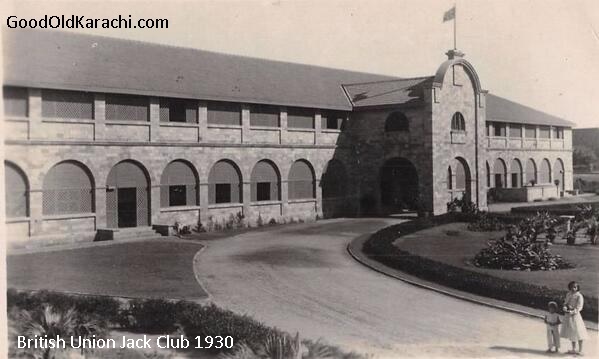
British Union Jack Club.

BritishUnionJackClub1930

British Union Jack Club 1930 This building is now Services Mess across from Hotel Metropole on Mereweather Road.

Posted in Contributions by British, Uncategorized | Leave a comment

St. Patrick’s Cathedral, Karachi.

cid:17.559125098@web37603.mail.mud.yahoo.com

St. Patrick’s Cathedral, Saddar, Karachi shares the grounds with St. Joseph’s Girls Convent.
Michael Ali The parish came into existence in 1845 but the church was built in 1878. The photo shows the monument which was built in 1931.

Posted in Contributions by Christians | Leave a comment

History of Memons

Here is a book by Mr. Anwar Motan
http://anwarmotan.com/history-of-memons/

History of Memons

By Mr. Anwar Motan

The question of Memons has always been close to my heart, and I have delved deeply into its origin. There has been some controversy as to the veracity of various versions. There have been attempts by many historians to lend unnecessary scholarly elaboration and color to the debut of our modest, magnanimous and devoutly religious society. The research is undoubtedly very thorough and verifiable, so much so, that it becomes complex and awkward for the layman. The reason for the investigation is undoubtedly to establish the fact that the advent of Memons was much earlier than the date propounded. However, this misguided scholarship merely confuses and obscures the whole issue by the introducing the Bohras, the Khojas, varieties of Ismailis, the Ishnasaries, the Shias and the whole issue of the propagation of Islam into the sub-continent of Indo-Pakistan, tracing it to Muhammad Bin Kasim.

The widely accepted version is that this community of Memons might have originated around the year 1422 C.E at a place called Nagar Thatta, then a capital, in the province of southern Sindh, then in Indiaand, what is now Pakistan. It seems such a modest claim, not needing a great deal of ado and glorification. Even if it is sucked from the thumb, as the saying goes, the passage of time has lent it a degree of authenticity, despite its record of somewhat questionable origin. The converts were first called Momins, and with the passage of time, the term changed to Memons. This is revealed in a book entitled Abraazul Haq, by Syed Ameeruddin Nuzat, under the guidance of one Peer Buzrug Ali, published in Bombay in 1873. The story related therein states that some 700 Lohanas families, (inclusive, perhaps of some earlier converts and neo-Muslim converts) comprised of some 6178 individuals, accepted Islam at the hands one Syed Yusufuddin Gilani. Finding themselves banished by their erstwhile Hindu brothers, they were eventually forced to migrate. This version has persisted over decades, to the extent that it was reiterated by one Hussain Kasim Dada at the first ever All India Memon Conference in Rajkot in the year 1931, and is in vogue even to this day.

Posted in Books on Karachi, Contributions by Muslims | Leave a comment

The Kabootar Baaz of Raja Mansion

By
Amin H. Karim
June 2018

KabootarBaaz


For those not familiar with the area, Raja Mansion area is located in the heart of Old Karachi. It is situated north of Civil Hospital Karachi and Dow
Medical College and is bounded by M.A. Jinnah Road (Old Bunder Road) to the east and Chand Bibi Street (old Princess Street) to the west It is predominantly a lower middle class neighborhood with 4-5 story residential buildings with retain at the ground level. The ethnicity is thoroughly mixed with indigent Hindus and Christians, new immigrants from North India and Gujarat. The streets serve for traffic as well as cricket and football field, not to mention a variety of local games such as soor pala, gilli-danda, and lattu. We street urchins ruled the streets barricading  the two ends whenever we felt like playing. Raja Mansion itself is a group of 5 brick buildings on the corner of Bejanji Street and Yakoob Khan Road which housed the local Police Station and their families.
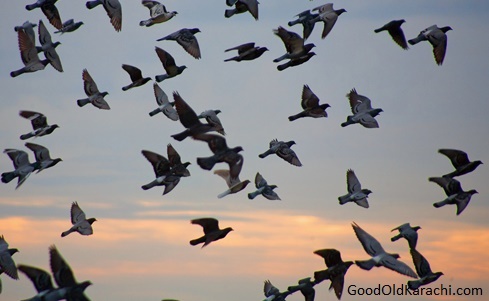
                    The Kabootar Baazi show would start daily between Asr and Maghrib. He would come to this roof, presumably after a hard day at work and an escape from his you-know-who. He would ascend up a safe wooden ladder that took him to the flat roof of the building.
Here he had a small cabin in which all his pigeons were housed. The pigeons knew it was time for them to come out of their dwelling and get some exercise. He would carefully unlock the door to his pigeon coop; A bunch of hungry ferre cats  perched on top of the water tank looked longingly with their mouth watering at the sight of juicy kabootar tikkas! But they dare not come near the pigeons unless they wanted to be socked by the Kabotar Baaz’s stick. Luckily there were no falcons in Karachi to attack them, the Karachi eagles being of the small variety and surviving on scooped up pieces of meat.
                  He would release them and they would all fly in one direction as if in a parade. They would go high and and then head north. He would watch them as they kept flying in a nice formation till they reached the populated limits of old Karachi, probably
all the way to  Gora Kabrastan. From here they would start their circle flying west towards Lyari River area, then towards Native Jetty Bridge and then east towards Queens Road and Bath Island, over Clifton and then back to Nursery area and repeat the round. ( I am just guessing these locations since I had no way of knowing where they were flying.)

                In the meantime The Kabootar Baaz would be watching patiently and after a few rounds would get nervous and start his call back routine, waving his stick with a white cloth at the end accompanied by whistling loudly. The pigeons knew it was time to head back home and would heed to his call. They would start reducing their radius till they came nearer the building and then they would descend in a flock to the roof, to be greeted by the Master and rewarded with a ample sprinkling of millet seeds which they would start picking with guttar goo gratitude.
               All this was simply amazing! But at that time never gave a second thought as to how on earth do pigeons home in to their dwelling from that far.  Even today, scientists are baffled as to how pigeons navigate. Several theories including the sun, the horizon, the earth magnetic field. One British study suggested that pigeons in the flock breakup into subgroups and follow a leader who is more experienced while staying with the crowd!

              Similarly amazing is the journey of the sea turtles from the wide ocean to the place they were born and salmon as they return after roaming and growing in the Pacific Ocean to their place of birth in the small rivers inland where they were born.

              As for the Kabootar Baaz, he had his fix for the evening having watched his pets get their daily jog; having fed and watered them he would tuck them in for the night and walk back to his flat. Me, I was just a interested spectator with neither the resources nor the desire to become a daddy catering to a bunch of kabootarz.

Amin H. Karim
Published on FaceBook group Karachi Past and Present. 2018

Posted in Karachi Neighborhoods | Leave a comment

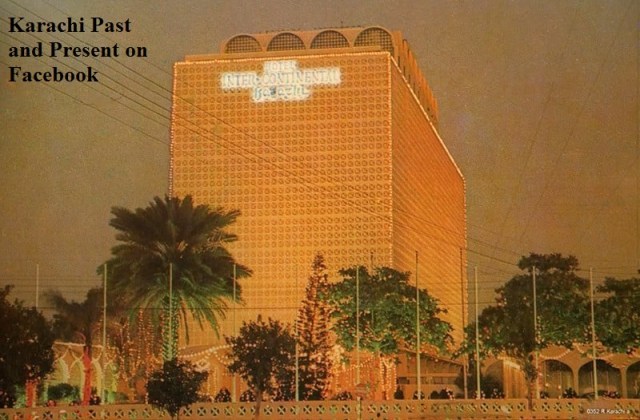
Intercontinental Hotel Karachi

INTERCONTINENTAL HOTEL KARACHI
By
Raju Jamil
JamilRajuSmall

ICH now PC was inaugurated on 2nd May 1961 with Bernard Holt, a French, as it’s first GM. It was one of the chain of the famous Intercontinental Group of New York. During its initial days, it’s most loved restaurant was “Nasreen Room” followed by “Chandni Lounge” (which has now become “Chandni Chowk”)….. It’s amazing 24 hours recluse was right on the left side of main PIDC house side entrance. “Demi Tasse” was its name….. it had awesome ‘waffle’.

HotelIntercontinental1980NewYearT

ICH had two branches of UBL and HBL. I remained posted at HBL on training during 1971 there when Pervez Shadani was the Manager.

It’s famous flower shop “Zerritta Flowers” was managed by Zarine Dubash who supplied fresh flowers specially imported from Holland for Javed Jabbar’s movie scene of “Beyond The Last Mountain” in 1973-74… The flowers which I destroyed in the scene we filmed at KLM Midway House at Karachi Airport,..in the movie.

ICH’s New Year Eve at Nasreen Room was dream come true…at Rs.500 per couple with dinner and live bank in attendance. Zafar Zehri of “Zafar Marbles” the owner of a unique Chevy Belair was often seen at the NY eve. Also popular at the New Year Eve as best dressed were; Rakhshinda Khattak, Shahnaz Ghani and Babs Chinoy.

It had an amazing swimming pool. Some scenes of the famous TV serial “Uncle Urfi” were recorded at the famous reception and lift of ICH in 1975. The start of the famous song by Rushdi “IK Urran Khatoula Ayega” was from the Karachi Gymkhana side entry of ICH in front if a gas station with Reza Fazli in action for a movie in 1968.

ICH turning into PC for sometime justified it’s ranking but slowly and eventually the 5 star status was withdrawn that I know of.

I met Noor Jahan, Zeba, Mohammad Ali, Tarana, Reza Faazli, Shabnam at the ICH decades back.

‎نیے طرزوں سے میخانے میں رنگ مے چھلکتا تھا
‎گلابی روتی تھی واں جام ہنس ہنس کر چھلکتا تھا

‎تیرے اس خاک اڑانے کی دہمک سے آئے میری وحشت
‎کلیجہ ریگ صحرا کا بھی دس دس گز تھلکتا ہے

‎گی تسبیح اس کی نزاع میں کب میر کے دل سے
‎اسی کے نام کی سمرن تھی جب منکا ڈھلتا تھ

Posted in Entertainment in Old Karachi | Leave a comment