Norman- The Man, The Legend

By:

RodriguezMenin
MENIN RODRIGUES

·SUNDAY, FEBRUARY 5, 2017
From rocking the 1970s to reaching 70 years of age, this man, the legend, has
played an unimaginable serenading role in transforming the music scene in
Pakistan like no other in his brand of crooning. He is, without an iota of doubt, an
iconic person and the epitome of ‘western music’ phenomenon in Pakistan. He is
NORMAN D’Souza.
And the good thing is, he shares his glorious 70 years this year with
Pakistan!
Norman’s contribution to the ‘popular’ variety of music and singing of the 1960s,
1970s and 1980s has been colossal; he is clearly one of the most popular
personalities of his era and continues to mesmerize audiences. As the lead
singer for some of Pakistan’s original live music bands, such as the Moon-Glows,
In-Crowd, Talismen, Keynotes etc; his voice alone could launch a thousand
people tapping their feet at discotheques, clubs and the party-scenes in Karachi.
When singing his favorite songs, his deep penetrating voice, powerful and soul-
searching, is familiar to the vocal chords of legendary artists such as Louie
Armstrong (What a Wonderful World); Frank Sinatra (My Way); Jim Reeves
(Put Your Sweet Lips); Billy Ocean (Caribbean Queen); Engelbert
Humperdinck (Please Release Me) and Tom Jones (Delilah).
Norman was among the first popular musicians to have been interviewed on
television’s mass-appeal ‘Zia Mohyuddin Show’ in the 1970s and also toured
Singapore with the Talismen, playing at the famed Merlin Hotel as the first pop-
band from Pakistan! One of his fans in the Far-East was none other than the
world boxing heavy-weight champion Joe Frazier! (See Picture)
Music and singing keeps him going. His 3-piece band today, including Gerard
Vanderlowen and Clifford Lucas is in great demand throughout Karachi at music
shows, club-evenings, weddings, family gatherings and special occasions. There
is no other group of musicians that can match this trio’s virtuosity in singing the
delightful songs of the golden era of music.
Above all, Norman has been a family man all through his life; his wife Nancy has
stood by him like a rock and his two girls Narissa and Nicole-Ann have made him
proud. I can recall the beautiful rendering of ‘But You Love Me Daddy’ which
Narissa sang as a 6-year old alongside Norman on the guitar. On the other hand,
the 70th birthday party surprise, aptly called “Vintage Dude” by Nicole-Ann was
indeed, very creative, thoughtful and stunning.
Though he is forever performing at some show or the other throughout Karachi,
he is always there in church lending his echoing voice at the daily morning Mass
at 6.30 a.m. and with his Sunday Morning Choir for the 8.00 a.m. service.
God bless you Norman. Keep going.

Posted in Contributions by Christians, Uncategorized | Leave a comment

Pakistan TV Karachi Shows in 60-70’s

PTV KARACHI’S MOST POPULAR FROST SHOW WE PRESENTED AS “GAR TU BURA NA MANAY”

JamilRajuSmall
*Raju Jamil*

“Sach Khedoun Aie Barhamin…Gar Tu Bura Na Maanay
Tere Sanam Kadoun Ke Butth Ho Gaye Puranay”

This famous verse of Allama Iqbal had a whole meaning that one of its line was adopted by PTV-Karachi’s GM Aslam Azhar to create a comedy show—the Frost Report of David Frost kind—-in 1969 as “Gar Tu Bura Na Maanay” which had Mohsin Shirazi as it’s “David Frost” supported by a stock cast of four; Zafar Masood, Mohammad Yusuf, Zahoor Ahmed and Shahnaz Ghani (of “BAMBI” child wear outlet since 60’s).

“GAR TU BURA MAANAY” (GTBNM) was hilarious and a parody of many of our customs held during marriages. It was mostly a satire well presented in a formidable style with boxed laughters and sometimes generating a roar of laughter from the viewers of the only network in Pakistan then.

The ongoing golden jubilee year of television in Pakistan…essentially PTV….has many a tales to talk about and remember–from each of it’s several centres which all–produced some most remembered dramas, talk shows and events which remain as infectious as ever. When the private networks will celebrate their golden jubilee—if they reach that point—all people will remember will be advertisements and political battles with no results they were subjected with …every day but never never on Sunday:)

GTBNM…. ran for several weeks and took a break when Aslam Azhar, the Wizard of PTV left for Islamabad on a higher assignment..later becoming the only and ever MD of PTV and later Chairman of PTV and Radio Pakistan. No one has held such combined assignment at Ministry of Information..here in Pakistan. Hail Aslam Azhar! He should be awarded NISHAN e Imtiaz on 26th November, 2014 when (or if) the Ministry of information finds time to celebrate such an important event of this wonderful Nation Pakistan. I am certain to have a million “aye’s” on my recommendation above for Aslam Sahab.

GTBNM…..made a come back in 1970-71 with the same name and this time Neelofer Alim Abbasi, Zeenat Yasmine, Qazi Wajid, Shakeel Chughtai, Khurshid Talat and myself were stock artiste and after a few weeks—my friend the producer Ishrat Ansari told us or rather gave us a surprise that the name of GTBNM has been changed to “Sach Jama Jhoot Battaa Dou” (Truth+Lies/2) which was presented before a live audience at the open air stage of Hotel Metropole. The excitement of East and West separation had gripped the Nation and in order to suitably stage a media war against our neighbours…this stage show turned into a satirical one focusing on our enemy….and indeed it was a success that the live audience was jam packed and the regular telecast was keenly awaited or in today’s nomenclature…the “rating” was very good ( I can never understand this anomaly of the word RATING which appears to be too sacred and pious for some of the networks—:) ha ha ha ha ).

GTBNM….from PTV-Karachi will always remain in the minds and memories of those 50+ who saw that beauty of the sitcom and such sitcom can never ever be produced again…..unless it’s sponsored which is one good thing to mess up something great of the last without risk–:)

Thank you Aslam Azhar Sahab, Mohsin Shirazi (where is he? How is he?) and so fondly the late members of the stock cast; Zafar Masood, Zahoor Ahmed, Mohammad Yusuf remembered. RIP all of them. The then viewers who are around these days do thank you for giving them an entertainment worth every second of watching it.

PTV has carved its name so strongly that it needs to continue with its great deeds well mixed with the achievements of past and the new dawn of current era.

“Sach Khedoun Aie Barhamin…
Gar Tu Bura Na Maanay

Tere Sanam Kadoun Ke
Butth Ho Gaye Puranay”

Raju Jamil,
PTV Drama Debut 2nd Dec-1967

Posted in Uncategorized | Leave a comment

Karachi Students on the March: Pre-Partition Book.

Courtesy of Mr. Aslam Khwaja and Mr. Safdar Nensey

Mr. Nensey wrote on our Facebook group ” Karachi Past and Present” on September 18, 2024: ” KARACHI STUDENTS ON THE MARCH – 1905 TO 1946 by Dayo Nathaney. The booklet was originally published on September 1946. However, I have a reprinted version of it printed by Progressive Kitab Publishers. It is worth mentioning that the booklet is dedicated to Hemu Kalani, a young freedom fighter from Sukkur, who was sent to gallow for his role and not divulging the names of other freedom fighters.”

KARACHI: A book on students’ movement in Sindh, especially Karachi, from 1905 to 1946 titled Karachi Students on the March by Dayo Nathaney has been reprinted.

It was launched at the Arts Council of Pakistan in 2021.

Providing background to the book, academician Dr Tauseef Ahmed said that there had been many movements in Sindh during colonial times and the Karachi students’ movement was also one of them. “There was the Reshmi Rumal Movement, the Khilafat Movement, which also earned support from Sindh. The book covers the students’ movement of that time, which should be relevant even today, especially for those researching student politics,” he said.

Author of several books Aslam Khawaja said that he discovered the book during the first Covid-19 lockdown last year. “My friends and I were sharing books when one of them sent me Karachi Students on the March from abroad. It gave a story that we didn’t know much about,” he said.

“But the book was also missing several of its last pages. We have, for the last one and a half year, been trying to find a copy of it that is complete. We have looked everywhere. There was a copy in the British Council library in London but that was also missing the same pages. Then we heard from a gentleman in France who claimed to have the complete version. We offered to buy his copy or even pay for the missing pages if he could scan those and send them to us. But after we told him which pages we wanted, he stopped corresponding. He has not replied in seven months now.

“So with the resolve that we will publish a complete edition if we find the missing pages later, we decided that we have tried everything for now and that we should publish the book as it is. We have left the missing pages as they are as you can see from the page numbers,” he said.

“It seems like the author of the book must have written more on Sindh. We are also searching for his other writings,” he said.

Sharing her review of the book, young Virsa Pirzada said that it made her realise that the students’ struggle of that time was not very different from the students’ struggle of today.

Waqas Anagia, a leftist student researching Marxism, said that the book shows how the students held their ground while making others to agree to their terms.

Senior journalist Sohail Sangi said that despite its missing pages, the book seemed like a complete document to him. “It s a very good reflection of Sindhi society of those days,” he added.

Prof Aijaz Qureshi said many of the students in that movement from 1905 to 1946 grew up to become party leaders. There was a need to have the book translated into Urdu as well as Sindhi, he said.

A young student of medicine, Elsa Qazi, read out a beautiful poem from the book ‘Marching Song of Students’.

Published in Dawn, November 10th, 2021

Amin H. Karim MD September 26 2024

Posted in Books on Karachi, Contributions by Hindus, Karachi History | Tagged , | Leave a comment

Karachi Directory 1937-38

This directory is an invaluable resource for studying Karachi in the pre-partition era. Names of places and old street names are alphabetically arranged. Many of these were changed post partition but some do remain (Campbell Street, Guru Mandir, Nanakwara, Clifton, etc) There are old ads and photos of government officers of the time.

Posted in Karachi History, Karachi Neighborhoods, Karachi Related Publications | Tagged , | 1 Comment

One Nation, One People, One Intense Call of Prayer

One Nation, One People, One Intense Call of Prayer

By Menin Rodrigues


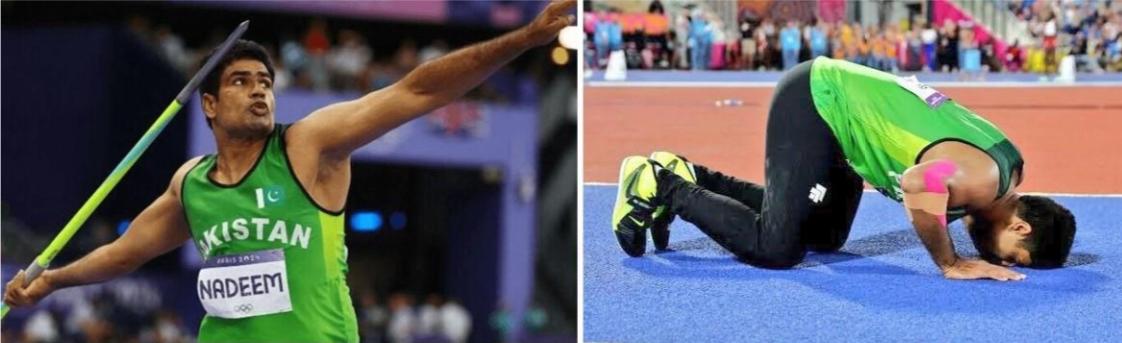
Global Village: August 8, 2024 – As Arshad Nadeem prepared to unleash his javelin into the air, the hallowed Olympic atmosphere at the Stade de France was electric. The arena, filled with 80,000 spectators, seemed to pause in anticipation, each breath held as the world watched.
Expectations were sky-high for the finalists, each a formidable contender with the potential to claim the gold. The line-up was a who’s who of elite javelin throwers, featuring some of the best in the world, including the reigning Olympic champion. With such a strong field, the competition promised to be nothing short of spectacular.


But amidst the tension and the grandeur of the Olympic Games, there was a quieter, yet equally powerful force at play—a call that transcended the physical world. It was the call of prayer, echoing from one nation, one people, and multiple beliefs that resonated through the heavens.
This collective prayer of Pakistan, reverberating through the spiritual ether, carried with it hopes, dreams, and an unyielding faith that would culminate in a moment of unprecedented glory. An Olympic track and field gold medal for Pakistan?

As Nadeem’s javelin soared through the air, it was as though the prayers of millions had lifted it, guiding it on a path to victory. The spear cut through the sky with a purpose, piercing not just the air but the very limits of possibility. It had crossed the threshold of glory.
When it finally landed, a hush fell over the crowd before erupting into a deafening roar. The distance of 92.97 meters was not just a new Olympic record—it was a triumph that defied the odds, a moment of magic that united an entire nation in jubilation. Pakistan had won its first athletic gold medal, a victory that would forever be etched in the annals of sports history.
Hailing from the humble village of Mian Channu in rural Pakistan, this robust 27-year-old had risen against all odds to achieve the unthinkable. Without the luxury of state-of-the-art training facilities or the guidance of a dedicated coach, he had stunned the world. Against all expectations, he now stood tall as an Olympic champion.


Across the world, Pakistanis from all walks of life—whether at home or in the farthest reaches of the diaspora—were glued to their television screens and mobile devices. They had witnessed something extraordinary, a moment that was as much about spiritual unity as it was about athletic excellence. Arshad knew that his parents, family, and his countryfolk’s prayers were heard as he dropped down and bowed before the Almighty.
In the aftermath of this historic win, the narrative of Arshad Nadeem’s Olympic gold would be told not just as a story of athletic prowess, but as a testament to the power of faith and the unity of a nation. The call of prayer that had accompanied his throw would be remembered as the unseen force that guided his javelin to glory, a symbol of the deep spiritual connection that binds the people of Pakistan.

© Menin Rodrigues.


Posted in Opinions | Tagged , | Leave a comment

Break the Silence of Silent Sufferers

By Dr. Sohail Ansari
Consulting Physician

There recently have been disturbing news of camel having legs amputated, donkey’s ears chopped off, death of a donkey who succumbed to injuries caused by torture and a dog thrown from a high-rise building. Last year negligence of animals in our zoos, and death of Noor Jehan, an elephant, had circulated in the media. In 2004 the City Government of Karachi ordered to kill the stray dogs by using different means, such as poisoning and shooting. A mass culling drive was carried out by a municipal department in Karachi last year. Such barbaric acts do not reflect well on any civilised society. Quran and Hadith guides us in our behavior to animals; human beings are allowed to use them, but only if their rights are respected. ‘All creatures on earth are sentient beings. There is not an animal on earth, nor a bird that flies on its wings — but they are communities like you’ (Quran 6:38). ‘And the earth, He has assigned it to all living creatures’ (Quran 55:10). One Hadith quotes Prophet Muhammad (pbuh) as saying: ‘A good deed done to an animal is as meritorious as a good deed done to a human being, while an act of cruelty to an animal is as bad as an act of cruelty to a human being.’

Rewind back, it takes one to the past when awareness of animal rights was being raised in Karachi, pioneering the way in India. Richmond Crawford who was the Collector had a reputation for his fondness for the welfare of animals. He dedicated two acres of land for the construction of a veterinary hospital in 1840’s which was named after him. It is now one of the oldest veterinary hospitals in Pakistan. Richmond Crawford’s idea gained momentum in 1878, a group of like-minded people started looking into it. On 18th May 1880, that group of revered noble citizens of Karachi including Sir William Lee Warner, Khan Bahadur Hassanally Effendi, Lagget Price, Sayed Hassan Mediru, Max Denso and Framroze Punthakey founded Society for the Prevention of Cruelty to Animals (SPCA) at Frere Hall Garden. Framroze Punthakey was chosen the honorary secretary. It was modelled after the Royal Society for the Prevention of Cruelty to Animals in the UK. The society not only raised awareness but also helped enforcing laws for the protection of animal rights in the city. It championed the cause. There were inspectors who patrolled the city and the owners found guilty of animal abuse were fined. For the welfare of animals to quench their thirst, water troughs were built across the city on the busiest thoroughfares, from Guru Mandir to Tower. Most were built under the shades of big old trees. Prevention of Cruelty to Animals Act was passed in India in March 1890 which still forms the backbone of current law. The act was periodically amended in 1917, 1923, and 1938 to keep it up to date.

Following independence, the West Pakistan Prevention of Cruelty to Animal Rules were enacted in July 1961. Fast forward: In Karachi, up to the eighties, the SPCA was led by Lady Nanette Constantine, a Swiss resident of Bath Island, as the society’s president. There were limited funds and manpower, but her determination was strong with untiring efforts to work for the cause of animal welfare. The activities included operations of an animal shelter with a capacity of 150 animals in Gulshan Iqbal, fighting a lawsuit for saving Richmond Crawford Veterinary Hospital (RCVH) from being bull dozed into a shopping mall and running a hotline for reporting of abuse within the city. She was threatened for defending RCVH, her house was ransacked and even her car was hit by a truck. Following her death arose a break in this century-old tradition of service to animals in the city. The SPCA shelter land was taken away by the government and the special animal court at the Sindh High Court wound up. Around sixty years ago, SPCA was concerned with encroachments especially by washermen on city’s water troughs constructed for animals. The society put out a request in the newspapers on 24th October 1966, seeking persons who could guard water troughs for animals against such infringements. It offered a nominal payment to the guards along with permission to open small shops in the space near the troughs. In the times of political turmoil such as curfews of 1969, SPCA provided animal hostel service to owners who found it difficult to provide food and veterinary services. A small number of NGOs are now helping out with the cause. A more contemporary initiative for the welfare of animals was taken by filmmakers Maheen Zia and Mahera Omar in 2004 when they founded Pakistan Animal Welfare Society. They may not have much infrastructure but rely on volunteers to rescue injured animals and coordinate with private veterinary clinics for the treatment. Ayesha Chundrigar Foundation rescues, shelters and rehabilitates injured animals. It uses social media to bring such incidents to light. There is a shelter that is functioning on the Karachi – Hyderabad Super Highway under the supervision of Edhi Foundation. This shelter is home to several cats, dogs, donkeys, crows and kites.
Most people in Karachi would have witnessed maltreatment of the animals, and yet ignored it. Such cruelty is a behavioral disorder. The state of pet shops, chicken in cages or animals waiting to be slaughtered and overloaded animals is a daily observance. There is a need to continue raising public awareness to change attitudes, as well for the authorities to enact laws, regulations and enforcement of those with fining the culprits.

Posted in Karachi NGOs, Opinions | Tagged , | Leave a comment

Karachi Sea Scouts

By Dr. Sohail Ansari

Gokuldas S. Ahuja was born in 1915. He was interested in sailing in Karachi. While working with an American company, with the assistance of number of ex-pats living in Karachi, he built a wooden sailing boat. The group enjoyed recreational and challenging aspects of sailing. This is how the Karachi Sea Scout Group was formed on 13 May 1938, at Chinna Creek with the support of Lt E W Oakley.

An old bus, donated by the tram company, provided its accommodation. In 1939, Sea Scout Council was formed with the Mayor of Karachi as its President and Dinshaw Avari its secretary. On 5 July 1942 the scouts saw a capsized boat in Chinna Creek and men drowning. They rescued and saved the men. Appreciating the courage of those scouts, the Commanding Officer provided them the needful equipment and place to carry out their training at HMIS Dilawar. Soon following that, in other incidences at Manora, the Karachi Sea Scouts rescued yet another group of RAF men and at Sandspit, the Royal Indian Navy trainees.

In view of their meritorious services 1939-1945 during the War, the Karachi Sea Scouts were awarded a couple of boats, Kandahar and Scrapper by Francis Mudie in 1946. Gokaldas Ahuja was granted honorary commission in the Royal Indian Navy Volunteer Reserve and later became Honorary Commodore. Jamshed Nusserwanjee supported the Sea Scouts.

By mid 1947, Mr Ahuja raised a large fund through the assistance of Karachi Port Trust, Jamshed Mehta Committee and public donations that led to establishing its headquarters in a ship that could not float, since it was made of concrete in the shape of a ship, a stone frigate. That was inaugurated by Jamshed Nusserwanji. After partition, Ahuja migrated to Bombay and Karachi Sea Scouts continued.

Open photo
Posted in Contributions by Parsis, Karachi History | Tagged | Leave a comment

Jay Walking on Karachi Streets

JAYWALKING ON KARACHI STREETS

By Menin Rodrigues

Preamble – Jaywalking (a North American term) laws vary by jurisdiction. In many countries such as the United Kingdom (and therefore, certainly Pakistan!) the word is not generally used and, with some exceptions, there are no laws limiting how pedestrians can use public roads.

Nonetheless, I am one of them, crossing wherever and whenever I want in my home country. Pedestrian jaywalking on the bustling streets of Karachi has become a longstanding issue, deeply rooted in the city’s history since gaining independence. This habitual disregard for traffic rules and the penchant for crossing streets anywhere but designated crossings has become integral to the urban landscape.

A glimpse into the past on social media, through 8mm films, videos, and photos portraying ‘Old Karachi’ or ‘Karachi of the Past,’ reveals a pattern of people strolling on roads, streets, and lanes rather than utilizing the available footpaths. This raises pertinent questions regarding the persistence of such indiscipline despite 75+ years since the nation’s inception.

Several factors contribute to this pervasive habit, with societal and infrastructural elements playing crucial roles. The lack of law enforcement is a notable factor. Over the years, the city’s law enforcement offices have struggled to consistently enforce traffic regulations, allowing traversing to persist without significant consequences. The lax enforcement of rules contributes to a culture of impunity, where pedestrians can disregard traffic norms without repercussions.

Lack of education and ‘careless’ behavior also play key roles in shaping pedestrian behavior. The absence of comprehensive education on road safety and civic responsibility may contribute to a lack of awareness among citizens. Suppose individuals are not instilled with a sense of responsibility and understanding of the potential consequences of jaywalking. In that case, they are more likely to engage in such behavior without considering its impact on traffic flow and safety.

Furthermore, the urban infrastructure may exacerbate the issue. Inadequate footpaths, poorly maintained crossings, and a lack of pedestrian-friendly features can discourage people from utilizing designated spaces for walking. When footpaths are narrow, uneven, or obstructed with encroachments, pedestrians may find it more convenient to navigate the streets directly, contributing to the perpetuation of jaywalking.

Addressing this issue requires a multifaceted approach. Strengthening law enforcement and ensuring consistent implementation of traffic regulations is essential to instill a sense of accountability among pedestrians. Education campaigns focused on road safety and responsible behavior can help raise awareness and foster a culture of compliance. Additionally, urban planning should prioritize pedestrian infrastructure, ensuring that footpaths are well-maintained, accessible, and integrated seamlessly into the urban fabric.

The prevalence of pedestrian jaywalking in Karachi is a complex issue influenced by historical patterns, law enforcement challenges, lack of civic education, and urban infrastructure. Tackling this problem demands a comprehensive strategy that addresses these various facets to promote a safer and more disciplined pedestrian environment in the city. How can we tackle this menace?

Image Credit: Team-BHP.com

May be an illustration

Posted in Transportation in Karachi | Leave a comment

CALL TO PRAYER

By Menin Rodrigues

2023 Flashback: CALL TO PRAYER, A SOURCE OF SPIRITUAL INSPIRATION

December 2023 – So, here’s a recollection: In the quiet moments of dawn, as the first rays of the sun gently caress the horizon, a profound and timeless ritual unfolds in Karachi and across cities and towns worldwide. It is a moment when the world is still asleep or just beginning to stir from its slumber, and the beauty of this awakening lies in the calls to prayer that echo through the air. The Az’aan and the chime of Church bells are the source of spiritual inspiration, a soul-searching connection to faith.

The Az’aan in Islam and the ringing of Church bells in Christianity are perhaps two of the world’s most iconic and resonant sounds. Beyond their religious significance, they hold a universal appeal that transcends boundaries and speaks to something deep within the human soul. My birthplace Karachi where I grew up and lived most of my life, gave me that feeling. It still resounds in my mind as I write these lines, giving credence to the fact that religious freedom in Pakistan is as sacred as the Constitution of the country in which it is lawfully embedded.

In his Christmas 2023 message, President Arif Alvi said, “minorities in Pakistan have full access to all political, economic, and social rights guaranteed by the Constitution.”

The early morning (Fajr) Az’aan is particularly poignant. The muezzin’s voice rises like a spiritual wake-up call as the city lies shrouded in a tranquil stillness. It’s a gentle reminder to the faithful that it’s time to turn their hearts and minds towards God, to seek His guidance and grace in the serenity of the pre-dawn hours. Similarly, the pealing of Church bells heralds the beginning of a new day, invoking a sense of reverence and contemplation. The chimes resonate far and wide through the crisp morning air, inviting people to prayer, worship, and reflection.

What makes these sublime calls to prayer so profoundly beautiful is not just their auditory charm but also the emotions they evoke. They are a stirring wake-up call to the soul, urging us to pause, reflect, and connect with the divine. The early morning call is a gentle nudge, a spiritual whisper that carries a promise of hope and renewal.

A unique spectacle unfolds as the calls to prayer resound across the city. People from all walks of life, young and old, from diverse backgrounds and experiences, begin to converge upon their respective places of worship. It’s a sight to behold as the faithful hurriedly walk to their places of worship with a sense of purpose drawn by an invisible thread of faith that binds them together. I recall my own experience in Karachi every morning when neighbors, friends, and acquaintances, in small numbers, would cross each other’s paths on the way to the neighborhood mosque and church and greet one another invoking a sublime connection to prayer. How many Western cultures can match up with this unique ‘daily’ connection with faith?

In this shared journey, there is a profound sense of unity and belonging. Regardless of the faith it represents, the call to prayer is a unifying force. It reminds us that we are all seekers, all yearning for a deeper connection with the divine. It bridges the gaps that sometimes divide us, reminding us that beneath our perceived differences, misunderstandings, and intolerance, we are all part of a larger spiritual tapestry.

Moreover, the beauty of these calls to prayer extends beyond their spiritual significance. They are an integral part of the cultural and architectural landscapes of cities and towns. The minarets of mosques and the steeples of churches rise majestically in Karachi, their distinctive features becoming landmarks that shape the identity of a place, and thus, the sound of the call to prayer becomes woven into the daily rhythms of life, creating a sense of continuity and tradition.

In an increasingly noisy and chaotic world, the calls to prayer serve as a serene oasis of calm. They are a reminder to slow down, to listen, and to reflect. In a world where distractions abound, they provide a moment of respite, inviting us to disconnect from the mundane and reconnect with the spiritual. Yet, in the West and in proverbial ‘cancel cultures’ it is now considered a breach of privacy and a source of disruption, and regrettably, both the pealing of bells and the Az’aan are now allegedly disallowed by law!

Therefore, as we bid adieu to 2023 and look forward to welcoming 2024, let us continue to hear the melodies and feel their resonance deep within our hearts. Let us allow them to awaken our spirits, to inspire us to lead lives of greater compassion, kindness, and understanding. The call to prayer, in my opinion, is a profound connection to our faith and to the shared humanity that binds us all.

May be an image of text that says '64 CALL TO PRAYER Source of Spiritual Inspiration!'

Posted in Karachi Recalled | Tagged , | 1 Comment

The Thrill of Karachi Driving

By Menin Rodrigues

Karachi Traffic

The Thrill and Challenge of Driving in Karachi: Navigating Chaos with Precision

DECEMBER 2023: Come what may, there is no scope for artificial intelligence and driverless cars here. Driving in Karachi is a unique experience that combines the thrill of navigating through chaotic traffic with the challenge of adhering to rules often overlooked by fellow drivers. The city’s roads are a maze where traffic lights, signs, and lanes exist, but are more of a suggestion than a rule. If you can master the art of driving in Karachi, the saying goes, you can drive anywhere in the world. This viewpoint explores the exhilarating yet demanding aspects of driving in this bustling metropolis. To me, it is like a pilgrimage to refresh my driving skills and to pay homage to my fellow masters of roadcraft!

The Dance of Precision – One of the first things that strikes a driver in Karachi is the seemingly synchronized dance of vehicles on the road. Despite the perpetual rush, drivers exhibit an uncanny ability to maneuver their vehicles with precision, mere inches away from one another. It’s a symphony of motion where every driver is a participant, carefully weaving through the traffic in a dynamic display of skill and daring.

In Karachi, might is right, and the unwritten rule is that the fearless on the road has the upper hand. Courtesies often take a back seat as drivers assert their presence with bold moves, weaving in and out of lanes (sic!) seemingly defying the laws of physics. The cacophony of blaring horns, treacherous potholes, and perpetual roadworks adds to the spectacle, creating a chaotic yet strangely orchestrated rhythm that defines the city’s roads. The real use of the steering wheel is not just for right and left turns but to make skillful and complicated maneuvers.

Navigating the Maze – The city’s roads present a tangled challenge that puts drivers to the test. Traffic rules are in place, but they are more like guidelines than strict regulations. Negotiating the intricate network of streets, flyovers, and underpasses requires a level of spatial awareness and quick decision-making that keeps drivers on their toes. Natural maneuvering intuition is the hallmark of Karachi drivers.

Traffic lights may change but their significance is often lost in the urgency of reaching the destination. The challenge lies not only in understanding the rules but also in adapting to the unspoken language of the road. Lane discipline is a luxury, with vehicles converging and diverging in a dynamic ballet that demands split-second judgments.

Pedestrian Roulette – In Karachi, pedestrians play a game of roulette when crossing the roads. The chaotic flow of traffic doesn’t deter them; instead, they navigate through the moving vehicles with confidence born out of necessity. Sidewalks (footpaths) are usually encroached by vendors of multiple kinds. Dodging cars, buses, and motorcycles, pedestrians weave through the traffic, making their way to the other side of the road.

The constant movement and unpredictability of pedestrians add an extra layer of challenge for drivers. Successfully navigating through this human obstacle course requires not only skill but also a heightened sense of awareness. In hindsight, a case of natural mental exercises. The city’s roads are a shared space where vehicles and pedestrians coexist in a delicate balance, each asserting their right of way in the urban jungle. It’s a way of life, no complaints, everyone’s happy.

The All-Hour Rush – Unlike many cities where rush hours are defined, Karachi presents a unique scenario – all hours are rush hours. The perpetual flow of traffic turns every moment into a challenge, and drivers must be prepared for the unexpected at any given time. It would confuse any GPS and AI App into disarray! The ability to maintain composure in the face of continuous congestion is a skill that sets apart the seasoned drivers of Karachi.

The true test of driving skills lies on the roads used by buses, trucks, cars, SUVs, taxis, rickshaws, donkey carts, motorbikes, and bicycles. These diverse vehicles create a dynamic and chaotic environment where drivers must anticipate and respond to a variety of challenges. Maneuvering through this eclectic mix is not for the faint-hearted but provides a thrill that resonates with those who dare to take on the streets of Karachi.

Driving in Karachi is not just a means of transportation; it’s an adventure that demands skill, precision, and a dash of courage. The thrill of navigating through the chaos, the challenge of mastering the unwritten rules of the road, and the constant test of one’s driving abilities make it an experience like no other. If you can conquer the streets of Karachi, you can undoubtedly tackle the roads anywhere in the world – and you can do that with or without a driving license or a seat belt, though it is mandated by law just like anywhere else in the world.

Posted in Transportation in Karachi | Leave a comment

Bicycles as a Means of Livelihood

By Menin Rodrigues

How a pair of wheels shaped our lives in good old Karachi.

HOMESTEAD: November 21, 2023 – In the days of our youthful exuberance, cycling was a passport to adventure, a vehicle of freedom that whisked us away from the mundane into a world of endless exploration. The wind in our hair, the rhythmic spin of the pedals, and the open road before us created a symphony of excitement. It may not have been a mode of transport for us like it did for many others, but it was a gateway to joy.

I am sure many of us have our own stories to tell and how cycling was a part of our lives, however, this recollection is about how cycling, as a means of livelihood, was a routine spectacle in the Karachi of yore – in this case, specifically the 1960s and 1970s. Here is a memory recall of who among the city’s visibly distinctive vendors used bicycles for their daily chores and economic sustenance.  

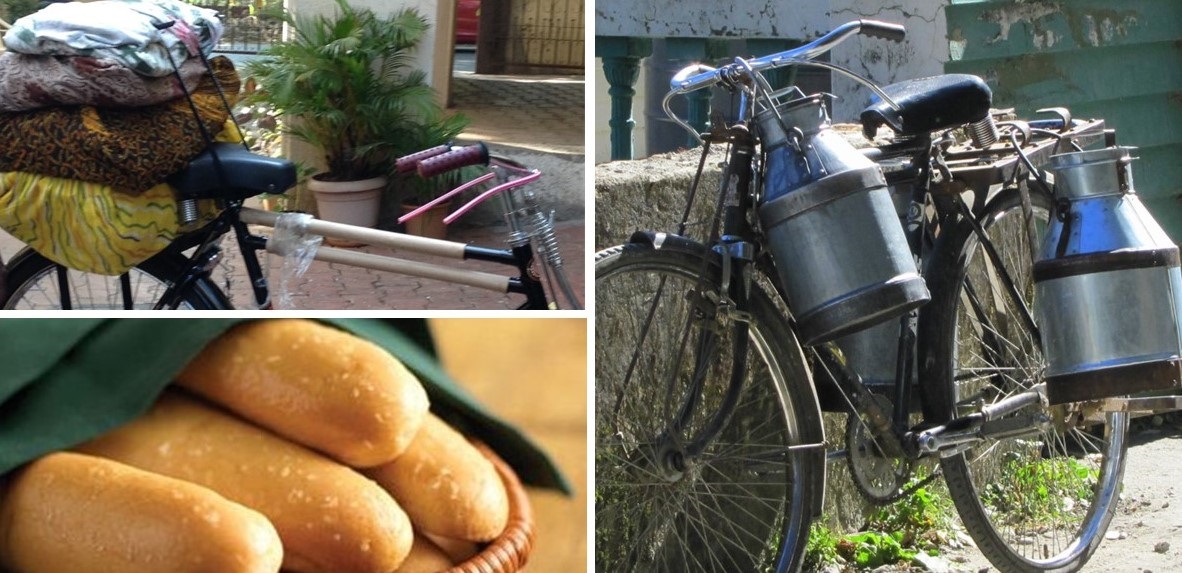
As the very first rays of dawn crept over the horizon, there was a familiar sight that became the harbinger of a delicious morning ritual in Karachi. It was the ‘Roti-Walla,’ who embarked on his daily journey, pedaling his way to your doorstep. His cargo consisted of woven baskets, laden with the enticing aroma of piping-hot ‘karak’ double roti. The ‘karak’ in the name had always held a particular fascination for me, akin to a captivating riddle that begged for an answer. What exactly made this roti ‘double’? Was it the layers of its soft, flaky texture, or was it the way it seemed to magically double the pleasure of breakfast? These early morning musings were an intrinsic part of this delightful ritual, where the ‘Roti-Walla’ not only delivered nourishment but also added a pinch of mystery to the dawn of each day, making each bite a moment of delectable intrigue and warmth.

After the ‘Roti-Walla’ had made his aromatic delivery, the ‘Doodh-Walla’ would gracefully roll into the neighborhood, announcing his arrival with the gentle clinking of milk cans. His trusty bicycle bore the weight of canisters filled to the brim with fresh, creamy milk, which exuded an irresistible fragrance of goodness. This daily spectacle was a cornerstone of life in Karachi, a reminder of how life was so simple then.

What truly distinguished the ‘Doodh-Walla’s’ role was the remarkable precision with which he executed his task. With dexterity honed by years of experience, he would deftly transfer the milk from his larger containers into smaller ones. These smaller vessels were perfectly calibrated to cater to individual homes or, in some cases, to traverse the labyrinthine lanes of multi-story buildings, where the milk was delivered from one apartment to another, and sometimes, from one floor to the next. The ‘Doodh-Walla’ was the quintessential milk conductor, ensuring that every household, regardless of its location or size, received its share of the freshly drawn dairy goodness.

Between 9:00 and 10:00 am, the ‘Machli-Walla’ would make his appearance, a cornucopia of fresh seawater fish straight from the Arabian Sea. Their sales pitch would echo through the neighborhood compounds as womenfolk eagerly clustered around their bicycles, peering into baskets packed with an array of fish, carefully preserved amidst mounds of ice. These peddling fish vendors of Karachi were a well-coordinated cohort, numbering about 500 in my estimate. They embarked on their daily odyssey to the harbor as early as 3 a.m., haggling for their day’s requirements. Returning to the city in groups of 20 or 30, they would fan out to their respective ‘mohollas’ or neighborhoods. Each ‘machliwalla’ had his allotted catchment area for business, and no other ‘walla’ would dare to infringe upon it.

The ‘Khana-Walla‘ (or the ‘Dabba-Walla’) followed closely between 10.00 and 11.00 a.m., an intriguing sight as several of them pedaled along, each of their cycles loaded with no fewer than 20 to 30 tiffin boxes (3 or 4-tiered), neatly stacked on both sides of their contraptions. Families entrusted their most cherished and ‘reliable’ service for the task of delivering home-cooked meals to their loved ones toiling in offices. Once again, these ‘khana-wallas’ numbered in the hundreds. They would gather the tiffin boxes from various neighborhoods and congregate at a designated roadside corner to sort them based on their ultimate destination. The tiffin boxes would then be exchanged with meticulous precision, ensuring not a single mistake was made in the process. These swapped tiffin boxes would be expertly delivered to their rightful recipients, only to return to the ‘exchange’ spot for reloading onto the original ‘khana-wala’ bicycle, ready for their next leg of the journey – back to where they had originally picked up their sets.

Following in this parade of service providers was the ‘Dhobi,’ pedaling his way to your door. His faithful bicycle often bore two towering stacks of bundled clothing: one stack consisted of freshly hand-laundered and crisply ironed garments, tied to the back carrier, while the other contained the ‘to be washed’ items, held tightly together on the handle. The dhobis, much like their fellow ‘wallas,’ were a highly organized and disciplined group of individuals. Dealing with a myriad of garments, bedsheets, towels, shirts, trousers, and more, they demonstrated an uncanny ability to never mix up their orders or deliveries. Garments that were returned after a thorough cleansing sported an immaculate finish, each crease and fold diligently pressed, with an abundance of starch to ensure they appeared as sharp as new.

In the tapestry of memories that weaves together the simple yet rich life in Karachi, the bicycle-wielding service providers stand as silent but cherished threads. Their daily arrival was a steadfast part of our existence, and their services were far more than mere transactions. These individuals became integral to our families, representing reliability and trust, etching their names in our hearts with the dependable turn of their bicycle wheels. Their generations still render some of these services.

In a world far removed from the hurried pace of today, where technology reigns supreme, the ‘wallas’ who brought their services (bread, milk, fish, food, and laundry) to our doorsteps on humble bicycles were the bearers of tradition, connection, and an era marked by personal service, community bonding, and the unforgettable charm of a bygone Karachi. © Menin Rodrigues

Posted in Transportation in Karachi | Leave a comment

Our Cake Wala in Garden East Karachi

By Micheal Meik

It was 1974, my Dad had just retired from the Pakistan Air Force and took a position as the Personnel Manager at National Motors. We moved from the Drigh Road Base to Soldier Bazar Garden East area, where we rented a home on D’Abreo Road, which was a street right opposite the front gate of the St. Lawrence Church and boy’s school. The first day there, we heard a man yelling at the gate “Cake Wallah”, Being ten years old, I was intrigued, as we hardly ever got vendors coming to the houses on the Air Force Base. Looking out the window, I noticed he was an older man with a long greying beard, riding a bicycle with a silver steel trunk on the back carrier. He spoke some English as well, and I saw all the neighbours coming outside, buying various biscuits, veggie patties and cream rolls from him. They told my Mom, you have to try his stuff, its really good, so Mom went out as well and bought an assortment of his biscuits. We were hooked from that day on.

A couple of years later in 1976 Dad decided that we should buy our home, so we found a ground floor apartment for sale in Taj Court on Maneckji Street, a ten-minute walk from where we were living. Just before teatime in the late afternoon we heard a familiar voice calling “Cake Wallah”, I ran outside, happy to see him. “Where is Mummy?” he asked. Inside I replied, so he yelled over the balcony wall “Memsaab, your cake man is here”. Mom came on to the balcony and bought some hot Butter biscuits, the crunchy layered Kharas, some Zeera biscuits, as well as these little flower-shaped chocolate biscuits with a round dot of chocolate in the middle, my favourite. He also brought the most amazing cream rolls and vegetable patties, similar in flavour to the ones we got in the school canteens. Sometimes Mom would even buy his plain pound cakes, they were always yellow inside and had this wonderful aroma and tasted of eggs and vanilla.

For the seventeen years I knew him, he seemed to look exactly the same, always an old man. I remember when we were little, he would show up while we were be playing outside. Taking the steel trunk off the back of his bicycle, he would put it on the ground, then move the upper tray of biscuits so we could have a better look inside. Then gathering all us kids together, he would ask how much money we had in our pockets.

Being the innocent children that we were at the time, we obediently empty our pockets and showing him, whatever change we had on us in the palm of our hands. Taking the money from each of us and would fill little brown paper bags with an assortment of biscuits and hand them to us. We got biscuits, whether we wanted them or not. They were good though, and he always gave us our money’s worth.

One day there was Martial Law and curfew was imposed in the city, the cake man got stuck in our compound. So, Khan, our chowkidar locked the gate, all of us children were outside playing, and our parents brought out chairs and were sitting in the compound. With our apartment being on the ground floor, we made a large daigchi of tea, our neighbours brought out different things to eat, there were pakoras, samosas etc. and I think that was the very first time the Cake Wallah had ever sold out of all his biscuits and cakes. Dad was in charge of the building maintenance at the time, and had just built Khan new living quarters, so Khan graciously offered the cake man a place to sleep for the night.

In July 1991, about a week before I was to leave Karachi to join my family in Canada, I was in the kitchen making myself a pot of tea, and there was a knock at the front door, it was the old cake man. He handed me a large plastic bag which weighed a few kilos, inside there were about a dozen of his small brown paper bags, each filled with one of the items we bought from him over the years, plus one pound cake and a marble cake. “Michael Beta, yeah Mummy ke liye kuch biscuit aur cake heah”. I was so touched by his kind gesture.

All those years of living there, and I did not realize he knew my name, I felt a little choked up, and invited him in for a cup of tea. Other than a few cushions, I had no furniture left, so we sat cross-legged on the floor in my empty living room, and for the first time, I actually had a chat with him. He told me that his father had been a baker before him, but he was not sure about the next generation, he felt that he would probably be the last in his family to do this. I told him “Baba, you know I won’t be able to carry this on the plane with me, as I was visiting England for a month, before going on to Canada. I offered to pay him, as it was a lot of stuff, but he adamantly refused, saying “No” to me in English “This is gift from Cake Man, I no take money”. So, I asked him out of all the thing he brought me, what his favourite was, he said the ginger biscuits, I pulled out the bag with the ginger biscuits and we had them with our tea, chatting for nearly an hour. He was remembering all the kids in the building that were now grown up, some even married with their own little ones. Then we heard some kids outside looking for him, as his bicycle was parked outside my balcony. He thanked me or the tea, wished me a safe trip, and left to tend to the kids outside.

That evening when Mom called me from Toronto, I told her about the Cake Man, so she asked me to call her back whenever he showed up again, no matter the time. So, at around 4:00 pm the next afternoon I heard him in the compound, I called out to him and asked him to come inside. I dialled Mom’s number in Toronto; it was about 6:00 am in the morning there. I handed him the phone and he had a long chat with Mom for nearly twenty minutes. He was so happy he got to speak to her, he handed me back the receiver saying, “mayra dil bohot khush hey, aaj Mummy say baat kia”. Giving me a big hug before walking out of the apartment, he thanked me for calling Mom. Forgetting all about selling his biscuits, he got on his bicycle and rode away waving to me. I saw him one more time after that and left Karachi a few days later.

He must have passed on by now, not sure if his sons ever took over from him, but I doubt it though. Being away from Karachi for nearly twenty-nine years, I wonder if vendors like the Cake Wallah still come around to the houses. It was a special memory that only ours and earlier generations would have experienced, that amazing fresh bakery aroma when he opened the lid of that steel trunk, the grease spots forming on the little brown paper bags as he filled them with the warm biscuits, and those flavours, each one different from the next.


Posted in Eateries of Karachi, Karachi Recalled | 2 Comments